

Beat Sales Rejection: Practical Steps Contractors Use to Bounce Back and Protect Margins

Hearing "no" over and over wears on any tradesperson. For contractors, rejected bids hit more than pride — they hit revenue, reputation, and the crew’s schedule. This guide walks contractors and subs through clear, practical ways to separate your identity from the outcome, sharpen emotional awareness, and turn rejection into repeatable learning that improves close rates and margins. You’ll get the why behind confidence drain and pipeline problems, a short playbook for building a growth mindset and daily resilience habits, objection-handling scripts for price and “think-it-over” pushbacks, and confidence drills that let you command better pricing. We include usable scripts, role-play drills, quick self-checks, and where to find focused practice and coaching — all framed for on-site use so you can start protecting margins and winning higher-quality jobs tomorrow.
What Is Sales Rejection and Why Does It Impact Contractors?
Sales rejection is when a homeowner or client declines your offer or proposal — and in contracting that refusal ripples through both psychology and the bottom line. On the people side, rejection triggers defensive moves: undercutting price, apologetic language, or avoiding follow-up. On the business side, each lost bid slows your pipeline and raises the cost of the next lead. Many contractors respond to early losses by dropping price or dodging tough conversations, which compounds revenue loss and weakens negotiating leverage. Seeing how these forces work is step one: it lets you build deliberate resilience and get back to consistent, predictable quoting that supports growth. Next we’ll look at how repeated rejection reshapes day-to-day performance on the job.
How Does Sales Rejection Affect Contractor Confidence and Performance?
When you take “no” personally, behavior changes fast: lower asks, shorter follow-ups, and less prospecting risk. Those moves cut close rates and squeeze margins. Repeated refusals teach quick defensive habits — apologizing, offering discounts first, and avoiding assertive proposals — and customers read that as lower value. Practically, you end up converting fewer good leads and chasing low-margin work, which messes with schedules and team morale. To break the loop, start small: list three recent lost bids, note the main phrase that triggered the rejection, and rehearse one calm, no-pressure reply for your next call. This tiny habit proves you can change behavior — and it points to the real fears driving those reactions.
What Are the Most Common Sales Fears Contractors Face?
Contractors usually name four core fears: price getting rejected, the sting of "no," not knowing what’s behind homeowner objections, and damaging future repeat business by pressing too hard. Each one has a direct reframe: treat price pushback as data about how you communicated value; see "no" as a chance to redirect; use objections as diagnostics to reveal real needs; and protect repeat work by clarifying scope and guarantees up front. These reframes are short mental scripts you can run before every appointment to lower emotional reactivity and gather better information. Use them often — they make the resilience practices that follow actually stick.
How Can Contractors Build a Resilient Sales Mindset?

A resilient sales mindset pairs a growth frame with small daily habits and enough emotional distance to treat rejection like data, not an identity hit. Thinking like an experimenter — a lost bid is feedback on your offer, timing, or wording — reduces avoidance and makes deliberate practice possible. Simple daily habits — a short post-visit journal, a two-minute debrief with a partner, and a weekly 15-minute role-play — speed up recovery and build muscle memory. Below are quick, field-ready resilience practices you can use right away to change how you respond on-site and in follow-ups.
- Set three micro-habits you do before and after sales conversations to reinforce steady behavior.
- Do a two-minute debrief after each customer interaction: what worked and one thing to test next time.
- Block one 15-minute role-play each week on your toughest objection.
Those small practices add up and naturally point toward group practice or structured training when you want outside feedback. For teams that prefer guided lessons and live Q&A, contractor-focused training turns these habits into repeatable skills without corporate fluff. Contractor & Subcontractor School offers tiered tracks — mindset foundations for tradespeople and deeper mastery for hands-on role-play — to speed habit formation while keeping the focus on field-ready techniques.
What Is a Growth Mindset and How Does It Help Contractors Overcome Rejection?
A growth mindset means you treat sales skill like something you can develop and see rejection as actionable feedback. That shift reduces taking "no" personally and pushes you to iterate on scripts, offers, and timing. It also increases the number of deliberate reps you do — more calls, more role-plays, more refined follow-ups — which raises the chance of wins. Try a seven-day micro-cycle: day 1 record a pitch, days 2–5 practice one script variation with a peer, day 6 field-test, day 7 review simple metrics and tweak. Plan, practice, test, reflect — repeat. Pair this loop with EQ techniques to stop reflexive, defensive reactions on the spot.
How Does Emotional Intelligence Improve Sales Resilience for Contractors?
Emotional intelligence helps you read homeowner cues, name emotions without matching tone, and respond with calm curiosity instead of getting defensive — which shortens recovery and keeps future options open. Three short EQ tools work well on site: label the emotion to lower heat ("Sounds like price is a concern"), use tactical empathy to mirror priorities ("I get it — you want the job done right and stay on budget"), and take a breath before answering to avoid instant concessions. These are brief, practical moves that fit a tradesperson’s direct voice: say it plain, then give space. Track a simple stat like "response recovery time" (how many minutes until you re-engage after pushback) to see real progress, and drill these moves in role-play until they’re automatic.
Research shows joint training and a focus on resilience can strengthen working relationships — useful when recovering from buyer-side trust breaks.
Building Relationship Resilience in Sales: Managing Buyer Breaches
This paper argues that joint training and deliberate resilience practices help repair buyer–supplier relationships when expectations are breached. It frames relationship resilience as a useful tool for managing buyer-induced breaches in collaborative projects.
Toward relationship resilience: managing buyer‐induced breaches of psychological contracts during joint buyer–supplier projects, L Kaufmann, 2018
What Are Effective Sales Rejection Strategies and Objection Handling Techniques?
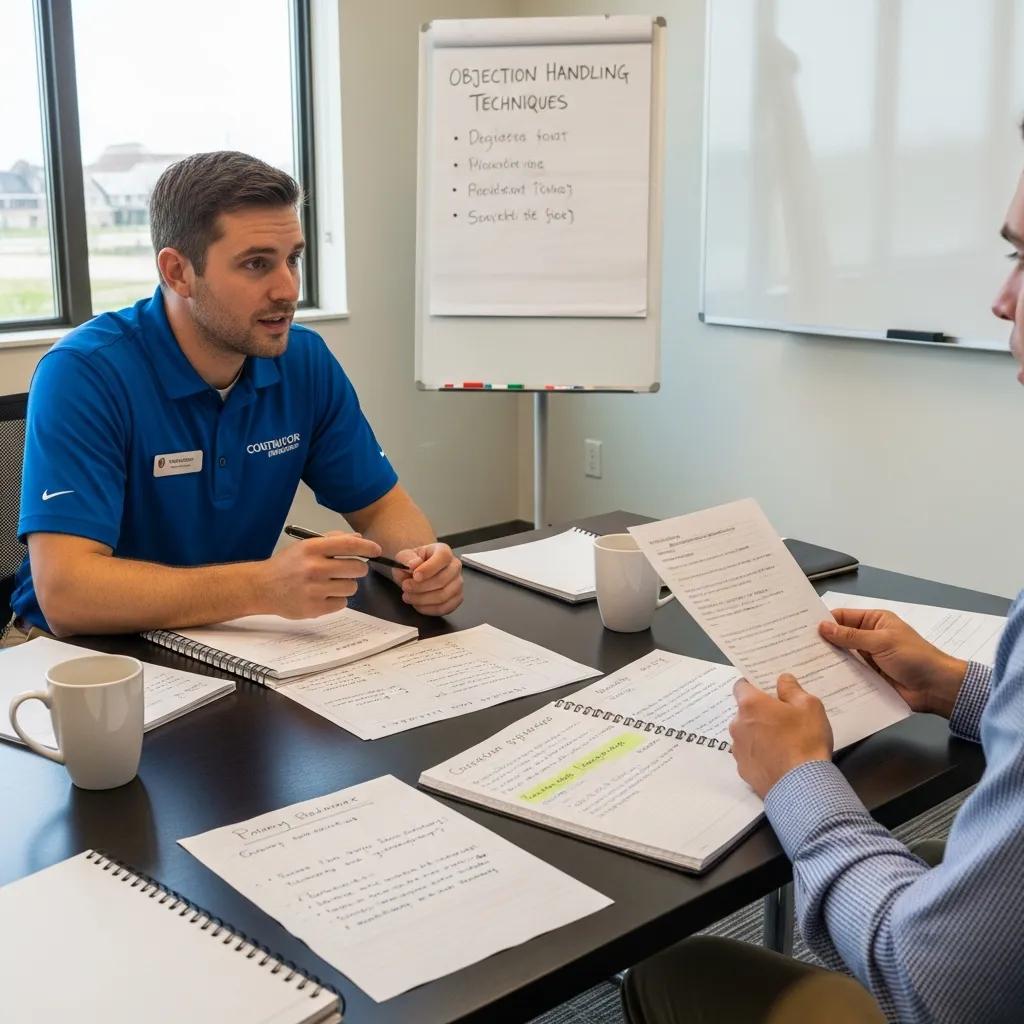
Handle objections in a predictable sequence: listen, find the real issue, probe for specifics, offer value or trade-offs, then confirm the next step. That flow prevents knee-jerk discounts and turns objections into clarity about scope, timing, or decision authority. Use structured scripts plus focused questions to avoid premature price drops. Below are top techniques and one-liners you can use on-site for fast impact.
- Active listening + isolate: "Help me understand — when you say the price is high, which part feels off?"
- Value-first reframe: "Most clients see fewer callbacks and longer life from this approach — here’s what that looks like for total cost."
- Conditional concession: "If we change the timeline or material mix, would that make this work for you?"
These moves work across homeowner types and should be practiced in role-play to speed adoption. The table below pairs common objections with the right technique and a short script you can use in the field.
| Objection Type | Technique | Example Script |
|---|---|---|
| Price concern | Isolate & link to value | "Which part feels expensive — labor, materials, or warranty? Let me show what the warranty covers and why." |
| "I need to think about it" | Isolate the reason | "Thinking makes sense — what exactly do you need to think through so I can help?" |
| "Shop around" | Create controlled urgency & differentiate | "Fair — when you compare, what matters most: timeline, warranty, or total cost? I’ll highlight that so you can decide." |
How Do You Master Price Objections in Home Improvement Sales?
Mastering price objections mixes anchoring, value-first language, and conditional negotiating so price becomes a factor, not an instant deal-killer. Start with an anchor: show a higher-tier option so your core offer reads as reasonable. Then quantify lifecycle value — how better materials cut callbacks and maintenance. Use three script styles for different buyers: analytical ("Here’s the line-item comparison"), value-focused ("This will save you over five years because..."), and deadline-driven ("This price holds if we start by X date"). Role-play each style, track which gets the most follow-ups, then standardize what wins. The table below helps compare approaches and likely outcomes.
| Approach | Best Use Case | Expected Outcome |
|---|---|---|
| Anchoring + downgrade options | Price-sensitive but quality-aware buyers | Keeps conversation on trade-offs and preserves margin |
| Lifecycle/value explanation | Analytical or long-term thinking buyers | Shifts focus from upfront cost to total cost of ownership |
| Conditional concession | When time or scope can be adjusted | Protects margin by swapping non-critical elements instead of cutting price |
How Should Contractors Handle “I Need to Think About It” and “Shop Around” Objections?
When a homeowner says "I need to think about it" or "I'll shop around," your job is to find the real hesitation, keep momentum, and set a low-friction next step. Try a three-part script: isolate ("What exactly do you want to think through?"), validate ("Smart — you want the right call"), and anchor a next action ("Would a 24-hour follow-up with a tightened scope help you decide?"). Follow-up checklist: send a one-page recap, include a clear choice ladder (timeline, price options, scope), and set one calendar-based check-in. That cadence turns passive prospects into timed decisions while keeping value intact. Track conversions after the first follow-up to see which cadence works in your market.
How Can Contractors Build Confidence to Charge Premium Prices?
Charging premium prices requires internal conviction plus visible proof. Confidence shows in how you present scope, your posture when you talk price, and the certainty in your timeline — and it’s trainable with role-play, micro-commitments, and social proof. Try three concrete exercises: a daily affirmation tied to one sales action, a weekly role-play focused on delivering price, and monthly collection of short client references or before/after photos that prove quality. The table below matches pricing strategies to confidence-building moves and the likely business impact so you can pick high-leverage actions to raise perceived value.
| Pricing Strategy | Confidence Technique | Expected Business Impact |
|---|---|---|
| Tiered offers (good/better/best) | Practice explaining scope differences | Higher average sale value and fewer discounts |
| Value-added guarantees | Role-play warranty conversations | More buyer trust and less price sensitivity |
| Fixed-scope premium packages | Collect and show job evidence | Stronger perceived value; better close rates for premium clients |
What Techniques Help Contractors Develop Sales Confidence?
Confidence comes from focused reps and small wins, not one-off pep talks. Fast accelerators include role-play with feedback, short recorded reviews, and keeping a visible log of weekly wins (signed change orders, client notes). Build a steady cadence: two short role-plays per week, one recorded pitch for review, and a weekly wins board. Use micro-commitments — pledge to use a phrase on the next two calls — and check in with a peer for accountability. Those habits create the behavior buyers read as competence, which raises willingness to pay.
How Does Confidence Influence Premium Pricing Success?
Confidence shifts buyer perception more than shaving price. When you present scope and guarantees with certainty, homeowners see lower risk and higher quality, which makes paying more an easier choice. Signs your premium message landed: steady eye contact, timeline questions, and clarifying scope — those are chances to reinforce guarantees and move to close. Contractors who shift from tentative to assertive price delivery usually see less discounting and higher close rates on the same offers.
Studies link higher emotional intelligence with better sales outcomes, often because adaptive selling behaviors flow from stronger EQ.
Emotional Intelligence and Sales Performance: The Role of Adaptive Selling
This study examines whether emotional intelligence drives sales performance and finds that adaptive selling behavior helps explain the relationship. In short: contractors who manage emotions and adapt their approach tend to perform better.
Emotional intelligence and sales performance. A myth or reality?, L Wisker, 2014
How Does Home Improvement Closer’s Training Support Sales Resilience?
Contractor & Subcontractor School (known in the field as Home Improvement Closer) runs tiered coaching that maps to the mindset and tactical skills above. The curriculum is built by contractors for contractors — no corporate fluff — and mixes short lessons, live practice, and community feedback. The path runs from mindset foundations to mastery in objection handling and role-play, up to ownership-level systems for scaling margins, plus optional 1-on-1 sessions for specific bottlenecks. Tier 2: Mastery focuses on objection scripts, price delivery, and sales psychology and is priced at $149/month, with live Q&A and community practice. Programs emphasize trades-specific language, resilience drills, and hands-on role-play, and include a 60-day money-back guarantee to lower enrollment friction.
| Program Tier | Key Skills Taught | Outcome / Price |
|---|---|---|
| Tier 1: Foundation | Mindset basics, core scripts, intro role-play | Consistent follow-up habits |
| Tier 2: Mastery | Advanced objection handling, pricing confidence, live role-play | Stronger conversion skills — $149/month |
| Tier 3: Ownership | Scaling sales processes, team coaching | Systems for higher-margin growth |
| 1-on-1 Consultation | Personalized diagnosis and action plan | Targeted fixes and next-step roadmap |
In construction, emotional intelligence is widely recognized as a factor that affects project performance and team outcomes.
Emotional Intelligence in Construction Contracting: Impact on Project Performance
This paper explores emotional intelligence levels in general contracting and how they relate to project performance. It highlights the role of interpersonal skills in successful project delivery.
Central contractor emotional intelligence in the construction industry, 2004
What Skills Does the Tier 2: Mastery Program Teach to Overcome Sales Rejection?
Tier 2: Mastery drills objection handling, confident pricing, buyer psychology, and resilience habits you can use on site. Short modules and live practice teach structured scripts for price pushback, isolation and probing for "think-it-over" answers, and daily micro-habits to speed recovery after rejection. Features include coach-led role-play feedback, community drills, and scenario playbooks written in contractor language. At $149/month, it’s designed as a practical step between basic mindset work and ownership-level systems for contractors who need regular practice and measurable gains.
How Do 1-on-1 Consultations Help Contractors Identify and Overcome Sales Bottlenecks?
One-on-one sessions diagnose your specific selling blockers — from scripts and follow-up cadence to pricing and proposals — and deliver a prioritized plan with quick wins. A typical session reviews recent lost bids, runs a role-play or pitch observation, identifies patterns, and sets three targeted experiments to run over the next two weeks. Personalized coaching accelerates progress by focusing on the highest-leverage behavior and cutting generic advice that doesn’t fit the field. For busy contractors, these sessions turn training into immediate, practical improvements you can apply between jobs.
What Success Stories Demonstrate the Power of Sales Resilience Training?
Field case summaries show the same pattern: contractors who commit to deliberate objection handling and mindset work win more, discount less, and attract better-fit clients. Program highlights emphasize before/after outcomes like stronger quoting confidence, steadier scheduling, and measurable jumps in average job value after adopting structured scripts and regular role-play. Common improvements reported by participants include:
- Higher close rates: more follow-up wins and fewer knee-jerk concessions.
- Greater average contract values: clearer price delivery and stronger evidence.
- Lower stress and better scheduling: fewer emergency, low-margin jobs.
Those results often push contractors into deeper practice through mastery tracks or focused consultations so gains become sustainable. Treating rejection as a skill — not a character flaw — produces real business effects.
How Have Contractors Increased Close Rates and Confidence with HIC’s Programs?
Contractors who use structured practice and role-play report clear behavior changes: tighter scope statements, fewer unilateral discounts, and faster recovery after on-site pushback. Tactics like anchoring, isolation questions, and conditional concessions turn into habits through short, frequent practice and coach feedback, and that habit change ties directly to willingness to ask for higher fees. Operational benefits follow: more profitable schedules, better project choice, and improved crew morale because selling becomes repeatable instead of risky. The community Q&A and coach drills give the accountability most contractors need to keep improving.
What Work-Life Balance Improvements Do Contractors Experience After Building Sales Resilience?
As contractors lift close rates and firm up pricing, they report real quality-of-life gains: fewer low-margin rush jobs, cleaner schedules, and more control over the clients they work with. Predictable margins reduce overtime and improve crew retention, freeing owners to step back from firefighting. Coaches note that financial stability from better selling also makes it possible to invest in systems that cut owner workload. Those business returns turn into human returns — more time with family and less daily stress — which is why resilience training pays off beyond the ledger.
Frequently Asked Questions
What are some common emotional responses contractors experience after sales rejection?
After a rejection, contractors commonly feel disappointment, frustration, or self-doubt. Those emotions can lower motivation and make future outreach harder. Knowing these reactions are normal helps you put coping tactics in place — short journals, peer debriefs, or simple grounding techniques — so you recover faster and approach the next opportunity clearer-headed.
How can contractors effectively follow up after a rejection?
Following up matters. Send a brief, polite note thanking the prospect and offering to answer questions — and include one helpful detail that keeps the door open (a timeline option, a short recap, or a clarification). Ask one clean question about their decision process to learn something, then set a low-effort next step so you stay present without pressuring them.
What role does practice play in overcoming sales rejection?
Practice builds confidence and chops anxiety. Regular role-play tightens your responses to objections and helps you find language that works. By simulating conversations, you can try different approaches, get feedback, and adjust quickly. Over time, this repetition reduces stress and makes handling rejection routine instead of personal.
How can contractors measure their progress in building resilience?
Track simple metrics: number of follow-ups after a rejection, lead conversion rate, and frequency of role-play sessions. Keep a short journal on emotional recovery time after pushback. Peer or coach feedback rounds out the picture. Those signals tell you whether resilience habits are actually changing behavior.
What are some quick techniques to boost confidence before a sales pitch?
Quick wins: two deep breaths to steady yourself, a 30-second visualization of a strong call, and reading one recent positive client note. Run a concise script aloud and remind yourself of one recent win. Stand tall, make eye contact, and lead with clear next steps — those moves show confidence even before you open your mouth.
How can contractors leverage client feedback to improve their sales approach?
Ask for feedback after jobs and on follow-ups. Look for patterns in what clients praise or complain about — price communication, timeline clarity, workmanship — and adjust scripts or offerings accordingly. Regularly reviewing feedback creates a loop of continuous improvement and helps you fine-tune the value you present.
Conclusion
Resilience against sales rejection is a practical skill, not a personality trait. With a growth mindset, short daily habits, and a few tested scripts and role-plays, contractors can turn losses into learning, protect margins, and win better jobs. If you want a structured path, the right training and coaching turn those habits into repeatable results. Start small, practice often, and the results follow — more confident pitching, steadier schedules, and stronger margins.