

Smart Home Sales Training for Contractors — Own the Smart Home Opportunity in Home Improvement

Smart home technology links connected devices, sensors, and cloud platforms to automate security, energy, entertainment, and everyday convenience. Contractors who know how these systems work and how to sell their real-world benefits win more jobs and boost revenue. This guide explains how the IoT-driven home automation market is changing what homeowners expect, which product categories matter most, and how to turn technical features into clear homeowner value during sales conversations. We tackle the field’s most common barriers—perceived complexity, price objections, and trust gaps—and give you practical scripts, upsell pathways, KPI metrics, and demo techniques proven in the field. Inside: 2025 market context, category comparisons, an objection-handling table mapped to the RPC approach, and repeatable sales playbooks that lift average order value and lifetime customer value. We close with the RPC Framework (Rapport, Professionalism, Close) and a summary of Home Improvement Closer’s training options, including a no-cost Tier 1 for contractors who want a structured introduction to selling smart home tech.
What Is Smart Home Technology and Why Is It Transforming Home Improvement Sales?
Smart home tech is simply the network of internet-connected devices—sensors, hubs, mobile apps, and cloud services—that automate and improve home functions for safety, energy savings, comfort, and entertainment. Devices gather data, communicate via local hubs or cloud protocols (including newer standards), and deliver measurable homeowner benefits: lower energy bills, better security, and daily convenience. For contractors this means shifting from selling parts to selling outcomes: peace of mind, predictable monthly savings, and homes that feel modern to buyers. Learning to sell outcomes rather than components lets you reframe price conversations as investments and makes smart features a standout value in remodels and retrofits. The sections that follow break down key product groups and 2025 trends so you can prioritize stock, demos, and pricing for the biggest impact.
Smart home categories create different sales hooks based on homeowner needs:
- Security systems: deter threats, improve monitoring, and raise perceived safety.
- Energy systems: smart thermostats and HVAC integrations that lower utility bills and show measurable ROI.
- Convenience solutions: lighting, voice assistants, and smart locks that simplify daily life and increase homeowner satisfaction.
Those purchase triggers point to specific devices and installation details contractors must focus on.
Which Key Smart Home Categories Should Contractors Know?
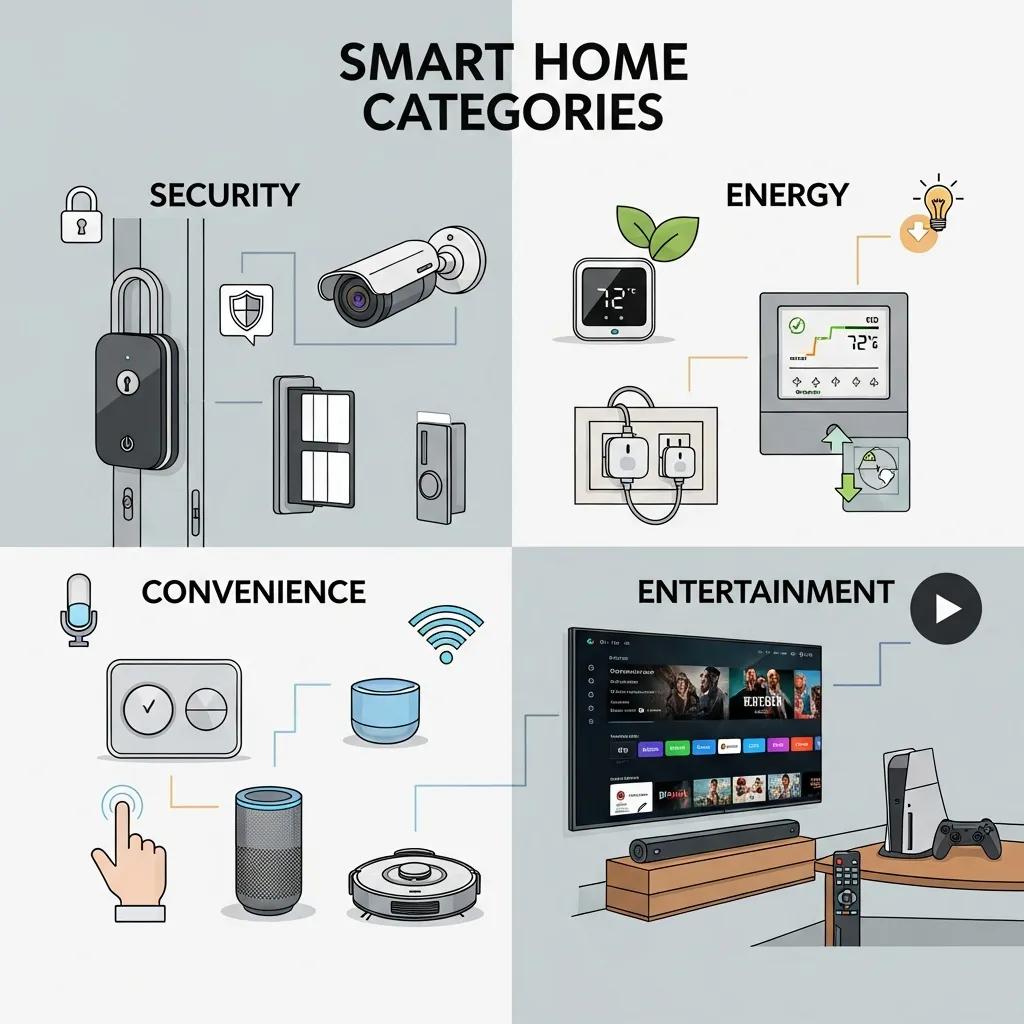
Prioritize four practical categories—security, energy, convenience, and entertainment—because each ties to a distinct buyer motivation and installation need. Security gear (locks, cameras, sensors) usually needs little structural work but demands integration know-how and clear privacy/warranty messaging. Energy items—smart thermostats and HVAC integrations—deliver quantifiable savings and sell well when you show amortized monthly returns. Convenience and entertainment (smart lighting, voice control, appliances) are lifestyle add-ons that attach easily to remodels or retrofit jobs. Presenting these systems as component sets—sensors, hubs, apps, and protocols—helps homeowners understand what they’re buying, reduces the tech-intimidation factor, and raises attach rates.
What Are the Latest Smart Home Market Trends for Contractors in 2025?
In 2025, homeowners are more willing to pay for integrated security and energy systems. Adoption is fastest among millennials and younger buyers, and wireless-first installs make retrofits quicker and less invasive. Interoperability standards are tightening, which shortens demo time and makes long-term support promises easier to keep—a credibility boost during sales calls. Security continues to drive revenue because buyers prioritize safety and insurance benefits; energy solutions attract ROI- and sustainability-minded customers. For contractors, subscription and maintenance revenue are growing: offering installation plus optional service plans consistently raises lifetime customer value. That trend leads directly into the sales hurdles you’ll face in the field and how to handle them.
How Can Contractors Overcome Sales Challenges When Selling Smart Home Technology?

Smart-home sales have predictable friction: perceived complexity, upfront cost objections, privacy and reliability concerns, and doubts about ongoing value. Complexity usually comes from unfamiliar interfaces and jargon; price pushback happens when homeowners compare component cost to unclear benefits. You address both by translating features into household outcomes and by showing monthly-equivalent savings. Practical tactics include short hands-on demos, simple amortization tables, trust signals (warranties and clear support plans), and discovery questions that reveal what homeowners truly value. Below are the top field challenges and the broad counter-tactics that work.
- Perceived complexity: use hands-on demos and plain-language analogies.
- Upfront cost concerns: show amortized monthly costs and ROI comparisons.
- Privacy/security fears: explain data handling clearly and back it with warranties.
- Reliability doubts: demonstrate compatibility and redundancy in tests.
- Value skepticism: sell outcome-focused bundles instead of isolated parts.
These challenge-to-tactic pairings set up the objection table that follows and map directly to the RPC framework—critical for consistent on-site closes.
What Are the Most Common Objections in Smart Home Sales and How to Handle Them?
Most objections fall into four buckets: cost, complexity, privacy, and future compatibility. Mapping each to Rapport, Professionalism, and Close gives you repeatable responses. Start by acknowledging the concern (Rapport), follow with evidence and credentials (Professionalism), then present low-friction choices (Close). The table below shows common objections, the RPC step that addresses them, and short scripts you can adapt on-site.
| Objection | RPC Step | Best Response (Short Script) |
|---|---|---|
| "It's too expensive." | Close | "If we amortize this over 36 months, your monthly cost is roughly X. With typical utility savings and possible insurance discounts, that often offsets the payment — which option fits your budget better?" |
| "I don't trust cloud services with my data." | Professionalism | "We use encrypted platforms and can set up local retention where needed. Let me show our data-flow and warranty so you can see how we protect your information." |
| "This sounds complicated to use." | Rapport | "Tell me one task you want automated — I'll demo a one-button routine so you can try it yourself and see how simple it is." |
| "Will this still work next year?" | Professionalism | "Most modern devices follow interoperability standards. We design systems with upgrade paths so you won’t be locked into obsolete tech." |
| "I don't want monthly subscriptions." | Close | "You can choose a one-time install and add an optional service plan later. Which gives you more peace of mind right now?" |
Summary: Use Rapport to validate concerns, Professionalism to prove competence, and Close to offer clear, low-risk choices that move the sale forward.
How Does Understanding Customer Psychology Improve Smart Home Sales Success?
Customer decisions are driven by four core motivators: security, status, convenience, and cost savings. Find which one matters most with targeted discovery prompts—questions like, "What part of home safety worries you most?" or "Which monthly bills would you like to reduce?"—and then align your solution to that driver. Social proof and short demos lower perceived risk, while tiered packages meet different comfort levels with tech. When you frame features as daily-life improvements or concrete savings, abstract tech becomes tangible value—exactly what the RPC Framework turns into repeatable sales steps.
How Does the RPC Framework Enhance Selling Smart Home Technology in Home Improvement?
RPC stands for Rapport, Professionalism, Close — a three-step sales method that builds connection, proves competence, and converts with confidence. Rapport opens the conversation with discovery and empathy. Professionalism demonstrates skill through concise demos, warranties, and a clear scope of work. Close presents structured choices and trial closes to reduce decision friction. Each step targets a specific friction point: technical anxiety (Rapport), credibility and compatibility (Professionalism), and price or commitment hesitation (Close). For teams that want structured training, Home Improvement Closer offers a three-tier program where Tier 1 covers these fundamentals for free, so crews can start applying RPC to smart-home conversations without upfront risk.
How to Build Rapport and Trust Around Smart Home Solutions?
Start with discovery questions that reveal homeowner priorities, then reframe features to match those priorities. Use quick live demos or a simple app walkthrough so homeowners get an immediate "I can use this" moment. Signal trust with warranties, documented field installations, and easy maintenance plans. End the rapport phase with a visualization question—"If this system handled X every day, how would that change your routine?"—to move smoothly into demonstration and proof, which is where Professionalism takes over.
What Professionalism Skills Help Contractors Become Smart Home Experts?
Professionalism is technical fluency plus tidy presentation and predictable follow-up. Know key terms (protocols, hubs, sensors), run pre-visit diagnostics, and carry a compact demo kit to show real functionality in minutes. Use a short pre-visit checklist—check Wi‑Fi, note HVAC interfaces, confirm panel access, and prepare two package options—to reduce surprises and look like the expert you are. Laying out a clear service path and compatibility documentation builds credibility and makes it easier to close higher-value packages.
The complexity of integrating IoT devices — including popular products like Nest thermostats — underscores the need for clear contracts and technical expertise on installation teams.
Contracting for IoT: Understanding Smart Home Complexity with Nest
This case study examines how connected devices—sensors, actuators, and cloud services—create contractual and technical complexity. Using Nest as an example, it highlights legal, licensing, and supply-chain considerations contractors should understand when offering integrated solutions. The paper stresses that clear contracts and defined responsibilities are essential when IoT products are part of installation scopes.
How to Confidently Close Deals on Smart Home Technology?
Closings work best when you reduce friction with structured choices and trial closes. Offer two or three tiered packages—a security-first starter, an energy-focused mid package, and a full automation ownership bundle—and use a direct trial close like, "Would you prefer the security-first or the energy-plus convenience option?" Present bundle pricing as a monthly-equivalent and always show a financing or phased-install option for budget flexibility. Keep technical detail light at the close: summarize homeowner outcomes, confirm next steps, and leave room for upsells and ongoing service offers.
What Advanced Sales Strategies Boost Smart Home Technology Revenue for Contractors?
Advanced tactics push average order value (AOV) and recurring revenue via service plans, subscriptions, and staged upgrades. Treat smart-home offerings as a platform with immediate and ongoing benefits, then use installation data to spot the highest attach rates and recurring needs. Typical playbooks sequence offers—security first, then energy optimizations, then convenience add-ons—bundle finance-friendly options, and track KPIs to know what converts best. For contractors ready to scale, training and peer support speed implementation: Home Improvement Closer’s Tier 2 (Mastery) at $149/month and Tier 3 (Ownership) at $250/month provide deeper playbooks and community coaching for teams focused on scaling smart-home revenue.
Intro to upsell table: Below links common smart-home features to practical upsells and the estimated additional revenue contractors can capture when selling bundles or staged upgrades.
| Feature | Upsell Opportunity | Estimated Additional Revenue / Value Proposition |
|---|---|---|
| Smart Security (cameras, sensors) | Monitoring subscription + add-on cameras | $200–$800 initial + recurring monitoring revenue |
| Smart Thermostat & HVAC Integration | Energy package + smart vents | $150–$600 initial + measurable monthly savings |
| Smart Lighting Scenes | Convenience bundle with voice control | $100–$400 upgrade; high attach rate in remodels |
Summary: Start with security to build trust, then cross-sell energy and convenience to drive consistent increases in project revenue and create recurring service streams that lift lifetime value.
How to Upsell and Cross-Sell Smart Home Features Effectively?
Upsells work when they’re sequenced and relevant. Install a security foundation first to establish trust, follow with energy upgrades framed as cost-saving investments, then offer convenience/entertainment as lifestyle enhancements. Use short demo stories that show combined benefits—for example, "Pairing cameras with smart lights reduces false alarms and automates lighting"—and present bundled discounts as value rather than just price cuts. Introduce upgrades during discovery, revisit them after a demo, and confirm selections in a brief written proposal that highlights monthly savings and optional service plans. Track outcomes and iterate based on your data.
Rapid smart-home growth in markets worldwide is changing buyer expectations and reshaping how homes are marketed and sold.
Smart Home & Prop-Tech: Redefining Home Buying in India
This research outlines how smart-home ecosystems and Prop-Tech platforms are transforming home discovery, decision-making, and post-purchase engagement in India. With smart-home penetration forecasts and Prop-Tech growth, the paper argues that digital housing tools and embedded home technology are increasingly part of buyer preferences and will shape market expectations going forward.
How Can Data and Analytics Improve Smart Home Sales Performance?
Data shows which features attach, which demos close, and which follow-up messages convert. Track key KPIs: close rate, average order value (AOV), feature attach rate, and recurring revenue per customer. Even simple analytics—spreadsheets or CRM tags that log feature interest and demo outcomes—let you refine offers and follow-up cadences. Close the feedback loop by sharing installer notes with sales, letting marketing use proven messaging to pre-qualify leads, and iterating offers based on what your metrics show.
How Does Smart Home Technology Increase Property Value and Customer Satisfaction?
Smart upgrades make homes more desirable by addressing safety, efficiency, and modern living expectations. When you frame systems as property-value enhancers, they shift from discretionary add-ons to investment-grade improvements. Evidence shows smart security and energy systems can improve listing appeal and may add measurable resale value when documented. Contractors who quantify energy savings, insurance benefits, and local comparables in proposals help homeowners see installations as assets—boosting satisfaction and justifying higher-ticket packages.
What Is the Impact of Smart Security and Energy Systems on Home Resale Value?
Smart security and energy features increasingly influence buyer decisions. Quantify impact with recent market indicators and local comparables in proposals; a conservative estimate can be presented as a modest uplift in buyer appeal or selling price. Document expected energy savings, inspection benefits, and comfort improvements so homeowners view the cost as an investment. Those numbers make amortization conversations and monthly-cost framing much easier.
How you frame security and value for homeowners influences adoption—and messaging can change how people perceive risk and benefit.
IoT Security Training: Gain vs. Loss Messaging for Smart Home Consumers
This study examines how gain- and loss-framed messaging affects consumer perception of smart-home security. It finds that messaging style matters: loss-framed messages can increase concern for users with low initial security awareness, while outcome-focused messages work well for users already worried about security. The takeaway for contractors: tailor your message to the homeowner’s starting level of concern.
How to Communicate the Long-Term Benefits of Smart Home Investments to Homeowners?
Translate technical specs into homeowner-centered metrics: monthly energy savings, possible insurance reductions, lower maintenance, and daily convenience. Use a simple amortization example that converts installation cost to a monthly figure and compares it to typical savings. Tailor the message to buyer type—value-focused owners want ROI numbers; convenience buyers want time-savings examples; safety-conscious homeowners want deterrence and monitoring proof. Always end the pitch with a clear next step: a trial, phased install, or a maintenance subscription that turns interest into action.
What Is the Future of Home Automation and IoT Sales for Home Improvement Contractors?
The near-term future centers on interoperability standards, simpler installs, and bundled service models that combine a one-time install with predictable subscription revenue. Emerging protocols that favor compatibility will lower long-term support costs and simplify sales of integrated systems. Important skills include interoperability basics, consultative selling to uncover homeowner outcomes, and basic data literacy to use installation metrics as selling tools. Prepare by building repeatable processes, training teams on platform-agnostic integrations, and designing service packages that deliver predictable revenue beyond the initial install.
How Will Emerging Technologies Like Matter Protocol Affect Smart Home Sales?
Matter and similar standards reduce fragmentation by letting devices from different makers work together reliably. That simplifies demos, reduces compatibility objections, and shortens install time. In sales conversations, position interoperability as a homeowner benefit—less vendor lock-in and simpler future upgrades—which boosts professionalism and homeowner confidence, leading to higher attach rates and lower support burden.
What Skills Will Contractors Need to Stay Competitive in Smart Home Sales?
Contractors should prioritize a compact skillset: technical basics (protocols, sensors, hubs), consultative selling (discovery and outcome framing), demo fluency, and data literacy for tracking KPIs. Training should scale with capability: foundation courses for core concepts, mastery programs for scaling and team processes, and ownership-level training for building recurring-revenue business models. For teams looking for structured pathways, Home Improvement Closer offers a three-tier program—Tier 1 (free) for fundamentals, Tier 2 (Mastery) at $149/month for implementation playbooks, and Tier 3 (Ownership) at $250/month for advanced business-building support—with community coaching and a 60-day money-back guarantee to reduce enrollment risk.
Concluding note: contractors who adopt these skills and systematize sales with frameworks like RPC are positioned to capture growing smart-home demand, increase average project revenue, and build recurring maintenance and subscription models that stabilize growth. The next step is to pilot these approaches on a small set of projects and iterate using capture metrics from each install.
Frequently Asked Questions
What are the benefits of smart home technology for homeowners?
Smart home tech delivers clearer security, lower energy costs, and everyday convenience. Devices like smart locks, thermostats, and lighting systems let homeowners monitor and control the house remotely, offering peace of mind. Optimized systems can cut utility bills, and well-documented installations can add resale appeal—so smart tech improves daily life while increasing property value.
How can contractors effectively demonstrate smart home technology to potential buyers?
Use short, hands-on demos that let homeowners try devices themselves. Show practical scenarios—how a thermostat learns preferences, or how a camera feed appears on a phone—and keep explanations in plain language. Visual aids, simple workflows, and a quick app walkthrough make the technology tangible and reduce perceived complexity.
What role does customer education play in selling smart home technology?
Education is essential. Clear, accessible explanations—via brochures, demo sessions, or short videos—help homeowners understand value, savings, and daily benefits. Answering common questions and correcting misconceptions builds trust and makes customers more likely to invest.
How can contractors address privacy concerns related to smart home devices?
Be transparent about data handling: explain encryption, where data is stored, and what homeowners control. Offer configuration options (local-only storage, limited cloud access) and back claims with warranties and support plans. Share real-world examples or testimonials that speak to privacy and reliability.
What are the key metrics contractors should track to improve smart home sales?
Track close rate, average order value (AOV), feature attach rates, and recurring revenue per customer. Also monitor demo-to-close conversion and customer satisfaction. Even simple CRM tags or spreadsheets reveal which offers perform best and where to refine your pitch.
How can contractors leverage customer feedback to enhance their smart home offerings?
Collect feedback via surveys, follow-up calls, and online reviews. Use that input to improve product selection, installation flow, and support. Show customers you acted on their feedback—this builds loyalty, increases referrals, and boosts repeat business.
Conclusion
Smart home technology gives contractors a clear path to higher-value projects and recurring revenue. By understanding key product categories, selling homeowner outcomes, and using the RPC framework, teams can increase close rates and customer satisfaction. If you want a practical, team-ready playbook, explore Home Improvement Closer’s training tiers and start building repeatable smart-home sales processes today.