

Expanding Outdoor Living Spaces: How Contractors Turn Backyards into Value and Lifestyle Wins

Outdoor living projects merge practical construction with lifestyle-driven design to expand usable square footage and boost market appeal. Recent market signals show well-executed outdoor scopes deliver measurable ROI — and contractors who link homeowner desires to clear value propositions win more bids. This guide breaks down what counts as outdoor living, why it moves the needle on both lifestyle and resale, and how sales teams can present these projects persuasively. You’ll find data-backed ROI ranges, the top 2025 trends, high-impact kitchen and patio features, objection-handling frameworks, and field-ready scripts and EAV references for consultations. Read on for tactical language, comparison tables, and training pathways you can use to turn interest into signed proposals.
What Are the Key Benefits of Expanding Outdoor Living Spaces?
Adding or improving outdoor living areas increases usable living space, enhances daily lifestyle options, and — when specified correctly — often delivers a strong cost-to-value return. Structurally, decking, patio extensions, and outdoor kitchens create functional square footage that buyers and appraisers count as valuable amenity space. Financially, sales teams can reference typical recoupment ranges and feature-specific ROI during discovery to anchor price conversations in measurable benefits. The sections that follow give concrete valuation ranges and homeowner-focused benefits sales teams can adapt into proposals and closing language.
How Does Outdoor Living Space Expansion Increase Home Value?
Outdoor living upgrades increase home value by adding usable, desirable space that buyers view as immediate lifestyle benefit — which can translate into higher offers and faster sales. Market indicators point to overall outdoor living upgrades returning in the low double-digit percentage range on home value, patios often recouping a large share of cost, and fully equipped outdoor kitchens sometimes driving even stronger perceived value. Appraisers and buyers commonly treat quality patios and kitchens as amenities that reduce perceived renovation needs, making price premiums easier to accept. Quick consultation script: “This scope adds living space for entertaining and typically recoups a meaningful share of its cost at resale,” — a good primer for value-focused design conversations.
Always pair numeric claims with conservative, local examples. The table below compares common projects and gives concise talking points sales teams can cite during client conversations.
Use this comparison as a quick reference to keep ROI messaging consistent across estimates and presentations.
| Project Type | Typical ROI / Value Indicator | Sales Talking Point |
|---|---|---|
| Patio (pavers/natural stone) | ~70% cost recoupment on average | "A well-built patio expands usable living and typically returns most of its investment at resale." |
| Outdoor Kitchen (built-in appliances) | Up to ~125% in feature-specific perceived value | "A high-end outdoor kitchen reads as a turnkey entertainment area and can strongly sway buyer preference." |
| General Outdoor Living Space (deck, pergola, fire feature) | ~10–15% uplift in perceived home value | "Integrated outdoor living zones add lifestyle utility buyers factor into offers." |
These benchmarks give sales teams precise, citable language for estimates and presentations. Next, we explain how those lifestyle benefits translate to daily homeowner value to strengthen emotional buying triggers.
What Lifestyle Improvements Do Outdoor Spaces Offer Homeowners?
Outdoor living areas create dedicated zones for entertaining, relaxing, family time, and wellness — priorities many buyers use to choose a home. For hosts, an outdoor kitchen and dining area turn the backyard into a ready-to-use venue; for families, covered patios and play-friendly surfaces expand usable space without moving. Buyers focused on wellness prize private outdoor retreats, fire features, and layered lighting that extend comfortable hours outside. During discovery, try persona-driven questions like: “Would you use this mostly for weekend dinners, quiet mornings, or active family time?” — it links lifestyle to scope and budget.
Tying lifestyle benefits to value strengthens proposals because it helps homeowners picture daily use and reduces price sensitivity. The next section covers the 2025 trends shaping homeowner expectations and how those trends create upsell opportunities.
What Are the Top 2025 Outdoor Living Trends Homeowners Want?
In 2025, homeowners favor multi-functional layouts, sustainable materials, and integrated smart systems — each offering clear sales angles. Multi-functional yards combine cooking, dining, lounge, and play zones for maximum utility per square foot. Durable, low-maintenance finishes lower lifecycle costs. Smart outdoor systems — automated lighting, irrigation, and remotely controlled appliances — add convenience buyers now expect. Framing upgrades as future-proof investments, rather than discretionary splurges, makes them easier to sell.
Here are the most saleable trends for 2025 and how to position them with homeowners.
- Multi-functional spaces: Lead with flexibility and year-round use.
- Sustainable materials: Emphasize durability, lower upkeep, and environmental appeal.
- Smart outdoor technology: Focus on convenience, energy savings, and improved ambiance.
Each trend addresses a common homeowner concern — flexibility, long-term cost, or convenience — making them natural upsell routes. The next subsection provides concrete multi-functional layouts and scripts for selling integrated features.
Which Multi-functional Outdoor Designs Are Most Popular in 2025?
The top-selling layouts mix cooking, dining, and lounge zones because they pack layered utility for both entertaining and everyday use. A high-conversion plan often pairs a built-in grill and beverage station next to a covered dining area and a lounge with a fire feature — sightlines and circulation that support big gatherings and quiet evenings alike. Sell through phased options: core kitchen and dining now, lounge upgrades later — lowering initial cost while keeping the overall design coherent. Try this line: “This layout gives you instant entertaining capability and a simple upgrade path if you want more seating or weather protection later.”
That sets the stage to add sustainable materials and smart tech as complementary upgrades, which we cover next and position as value-adds for discerning buyers.
How Do Sustainable and Smart Outdoor Technologies Influence Buyer Decisions?
Sustainable materials and smart systems sway buyers by cutting maintenance, lowering operating costs, and signaling modern, responsible design. Durable decking, permeable pavers, and corrosion-resistant fixtures reduce long-term upkeep — a persuasive point for cost-conscious and aging buyers alike. Smart features like programmable lighting, automated irrigation, and appliance controls increase ease of use and can be demoed as convenience and security upgrades. Present these as phased investments and include lifecycle savings estimates or financing options to soften premium costs.
Framed this way, sustainable and smart upgrades justify higher specification levels while keeping the initial project aligned with homeowner budgets. Next, we move to specific kitchen and patio features that deliver the strongest ROI.
How Can Outdoor Kitchen and Patio Designs Boost Home Value and Appeal?
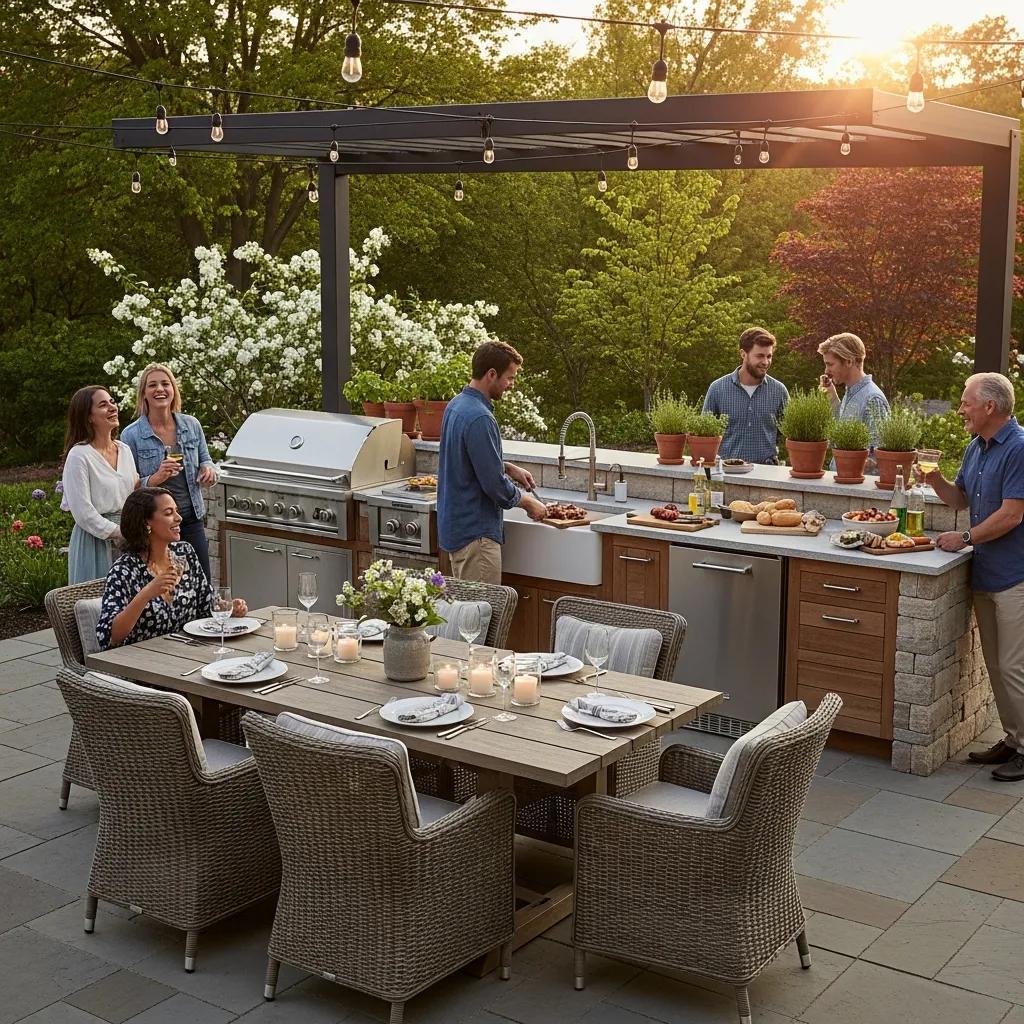
Outdoor kitchens and patios convert yards into functional, differentiated living areas buyers can picture using right away. Kitchens with built-in appliances and durable surfaces lower perceived post-purchase renovation needs, while extended patios add quality usable square footage. The result is stronger buyer preference and often quicker sales or higher offers. Below we list high-impact features and give sales language contractors can use to tie features to ROI.
When budgets are tight, lead with durable finishes and high-impact appliances; then layer lifestyle elements for emotional appeal and market signaling. The table below matches features to focused sales talking points and ROI rationale.
| Feature | Sales Talking Point / ROI |
|---|---|
| Built-in grill & prep counter | "A turnkey cooking area buyers see as ready-made entertaining space — often a strong preference driver." |
| Pizza oven | "A high-appeal focal point that signals premium outdoor living and can justify a higher offer in lifestyle markets." |
| Beverage station or refrigerator | "A convenience upgrade that completes the cooking zone and boosts perceived functionality." |
| Durable stone countertops & paver surfaces | "Low-maintenance materials that cut lifetime costs and appeal to practical buyers." |
This feature-to-language mapping helps sales teams define packages that align with homeowner goals while justifying premium items. Next, we cover which design elements deliver the best ROI and how patio extensions influence homeowner decisions.
What Outdoor Kitchen Design Ideas Deliver the Best Return on Investment?
The best ROI comes from durable appliances, weather-rated materials, and layouts that maximize utility while minimizing upkeep. Built-in appliances, corrosion-resistant cabinets, and stone or porcelain counters give buyers a sense of permanence and reduce replacement risk. Recommend a strong core kit — a reliable grill and a compact beverage station — then add specialty items like a pizza oven or full refrigeration for clients who entertain heavily. Try this upsell line: “Start with a core kitchen that covers daily needs; add specialty items later if they match your entertaining habits.” Framing upgrades as choices, not pressure, helps homeowners feel in control and more open to higher-spec options.
When contractors present cost alongside long-term value, homeowners are likelier to accept initial scopes that include durable materials.
What Are the Benefits of Patio Extensions for Homeowners?

Patio extensions add usable square footage, improve flow between inside and out, and often offer a better cost-to-value ratio than interior renovations. Small additions — a covered dining spot or a wider paver area — boost daily usability; larger extensions with built-in seating and layered lighting create true outdoor rooms that change how a home functions. Offer clear examples: a compact 50–100 sq ft extension for everyday dining versus a 200+ sq ft build for full entertaining setup, and discuss drainage, covering, and lighting early to avoid surprises. Client-facing line: “This option adds outdoor living you’ll use year-round and typically recoups a large portion of its cost.”
Next we cover sales strategies that translate these design and ROI points into signed contracts.
How Do Home Improvement Sales Professionals Sell Outdoor Living Spaces Effectively?
Effective selling starts with discovery that surfaces homeowner motivations, then uses tight presentation techniques that emphasize value over price. A structured sales flow — open lifestyle questions, visual concepts, and ROI anchoring — reduces price sensitivity and speeds decisions. Presentations with before/after imagery, a one-page value summary, and phased pricing options give homeowners clarity and control. Follow these tactical steps to convert interest into commitments.
- Open with discovery questions to reveal use-cases and priorities.
- Use visuals and mood boards to align expectations and validate taste.
- Anchor proposals with ROI snapshots and phased upgrade plans to reduce sticker shock.
These steps create a predictable path from discovery to close and prepare salespeople to handle objections using data and staging. The following subsections outline rapport-building and presentation tactics you can use in the field.
How Does Building Rapport Help Understand Homeowner Outdoor Visions?
Rapport uncovers the priorities that drive scope and budget decisions by encouraging homeowners to describe how they’ll use the space. Use open-ended lifestyle questions, reflect details back, and show material samples or photos to confirm preferences. When a contractor paraphrases — “So evenings with friends and an all-weather dining spot matter most” — it proves understanding and gives permission to recommend features that match priorities. Listening this way leads to more accurate scopes and fewer costly change orders.
Strong rapport naturally leads into a professional presentation that turns the homeowner’s vision into a clear, purchase-ready plan.
What Professional Presentation Techniques Showcase Outdoor Living Value?
Professional presentations use a clear visual sequence and concise data to show how design choices map to lifestyle and resale. Start with a one-page value summary: homeowner goals, a visual concept and material board, then a cost/ROI snapshot and phased pricing. One-page summaries with a clear next step reduce friction at sign-off; include warranties, timeline expectations, and a short reference list to lower perceived risk. These structured materials give contractors a repeatable way to present complex outdoor scopes as straightforward investments.
After presentations, objections still occur; the next section covers proven objection-handling frameworks tailored to outdoor living projects.
How Can Objections About Outdoor Living Projects Be Overcome?
Objections about cost, disruption, and timelines are common, but structured responses, financing, and phased builds lower resistance. Address cost by breaking scope into priority phases and showing lifecycle savings from durable materials. Counter disruption fears with clear timelines, milestones, and warranty commitments. Use social proof — past projects or short case scenarios — to normalize the process and shorten decision timelines. The table below is a quick objection-response reference sales teams can use on site.
| Objection | Root Cause | Response / Proof Point |
|---|---|---|
| "It costs too much" | Value not demonstrated | Offer phased options, show ROI snapshots, and explain material life-cost savings to reframe as an investment |
| "Project will be disruptive" | Fear of timeline and mess | Provide a staged schedule, a communication plan, and examples of smooth past installs |
| "I'm worried about maintenance" | Perceived long-term upkeep | Recommend low-maintenance materials and outline lifecycle savings plus warranty coverage |
Use this quick-reference table to deliver concise, data-backed rebuttals that move conversations toward workable solutions. The following subsections offer scripts and packaging ideas for budget and complexity objections.
What Are Effective Strategies for Handling Budget and Pricing Concerns?
When budget concerns appear, lead with value and phased delivery: break the full vision into a core scope that meets daily needs, then offer optional upgrades. Present financing options, deposit structures, and a clear ROI narrative so homeowners see how the investment ties to lifestyle and resale. Try: “We can prioritize the features you’ll use every day and add specialty items later when it fits your budget.” Pair phased plans with a one-page cost comparison and conservative recoupment estimates to keep credibility high and sticker shock low.
This approach flows naturally into complexity management by showing how staging and warranties reduce perceived risk.
How Can Sales Professionals Address Concerns About Project Complexity?
To reduce complexity fears, present a phased plan with clear milestones, regular communication checkpoints, and warranty coverage. Offer an on-site protection checklist, a communication cadence (for example, weekly updates), and a cleanup protocol to demonstrate process control. Share brief portfolio snapshots of similar projects completed smoothly to build confidence without long explanations. Finish with a firm timeline and a contingency statement — operational detail like this reassures homeowners and often closes the gap between approval and signature.
The next section ties these sales tactics to a training pathway that helps teams adopt them consistently.
Why Choose Home Improvement Closer’s RPC Framework for Selling Outdoor Living Spaces?
Our RPC Framework — Rapport, Professionalism, Close — addresses the core sales challenges contractors face with outdoor living projects. Rapport surfaces homeowner motivations and lowers price sensitivity. Professionalism packages complex designs into clear, visual proposals. Close provides structured objection flows and sign-off mechanics. Home Improvement Closer teaches this approach through an online, three-tier training program that includes field-ready scripts, presentation templates, and objection-handling flows tailored to contractors and sales teams. The program is built for fast adoption and measurable improvements in close rates.
Enrollment is flexible to match how deeply teams want to train: Foundation Tier 1 is free with no credit card required, while paid tiers add coaching and resources with monthly and annual billing options. Our method emphasizes psychology-first selling and practical templates so teams can use techniques immediately in outdoor living consultations.
How Does the RPC Framework Improve Closing Rates on Outdoor Projects?
RPC shifts conversations from price to value — start with rapport to learn why the homeowner wants the space, follow with a professional, visual presentation that ties features to goals, and finish with structured closes that reduce second-guessing. Psychology-first techniques reframe objections into phased-scope opportunities and use social proof plus ROI data to validate investment decisions. Short case examples and role-play exercises increase retention and field confidence. These practices create repeatable outcomes that reduce lead drop-off and improve conversions on higher-value outdoor projects.
Practical RPC takeaways include scripted discovery questions, one-page value summaries, and phased pricing templates that make decisions easier for homeowners.
What Are the Advantages of Online Sales Training for Outdoor Living Professionals?
Online training delivers modern sales frameworks without pulling crews off job sites. Short, on-demand modules let busy contractors learn and apply techniques between estimates. Combined with community support and optional 1:1 coaching, online training accelerates behavior change and provides accountability through peer feedback and practice. Paid tiers add structured coaching and deeper resources; Foundation Tier 1 gives a free entry point to core concepts without upfront cost. Home Improvement Closer backs paid tiers with a 60-day guarantee and centers the RPC Framework as the primary methodology for improving close performance on outdoor living bids.
Teams ready to apply these tactics should start with free foundational training and layer coaching as they scale higher-value outdoor offers.
Frequently Asked Questions
What types of outdoor living spaces are most popular among homeowners?
Homeowners increasingly prefer multi-functional outdoor areas that combine cooking, dining, and relaxation. Top features include outdoor kitchens with built-in grills, comfortable seating zones, and fire features. Covered patios and pergolas remain popular for shade and weather protection, extending usability year-round. These spaces act as extensions of the home and appeal to a broad set of buyer priorities.
How can homeowners maintain their outdoor living spaces effectively?
Maintenance is mainly routine: regular cleaning, seasonal inspections, and timely small repairs. Keep patios and decks clear of debris to prevent mold and mildew, check furniture and appliance wear, and maintain landscaping. Choosing weather-resistant materials reduces upkeep and helps homeowners enjoy their spaces with less hassle.
What are some cost-effective ways to enhance outdoor living spaces?
Small upgrades yield big impact: add outdoor lighting for ambiance and extended use, choose native plants for lower water and maintenance needs, and use modular furniture for flexibility. DIY projects like raised garden beds or a simple fire pit can boost functionality and curb appeal without a large investment.
How do seasonal changes affect outdoor living space usage?
Seasons change how homeowners use outdoor areas. In warm months, they’re used for entertaining, dining, and relaxation. Cooler months often prompt additions like heaters, fire features, or weatherproof furniture for year-round use. Retractable awnings, pergolas, and layered lighting help adapt spaces across seasons.
What are the environmental benefits of expanding outdoor living spaces?
When done with eco-friendly materials and practices, outdoor projects can improve drainage with permeable pavers, support biodiversity with native plantings, and reduce water use. Thoughtful landscaping and responsible materials help homeowners create attractive spaces that also benefit the local environment.
How can outdoor living spaces improve social interactions?
Well-designed outdoor areas foster social life by creating inviting settings for gatherings. Outdoor kitchens and dining zones encourage shared meals; comfortable seating promotes conversation. These spaces host family events, barbecues, or casual get-togethers, strengthening social connections and creating memorable experiences.
Conclusion
Expanding outdoor living spaces adds practical square footage and meaningful lifestyle value that buyers notice. Thoughtful features — from compact outdoor kitchens to multi-functional patios — can improve daily living and strengthen resale appeal. Contractors who understand trends, present clear ROI, and use structured sales tactics will convert more leads into signed proposals. Ready to get started? Explore our resources and training to bring outdoor living projects to the next level.