

Effective Needs Assessment: How Contractors Uncover Homeowner Pain Points to Close More Sales

Effective needs assessment is the on‑site process contractors use to find both the obvious and hidden homeowner problems so you can propose the right fix and win the job. This piece gives field-ready methods for diagnosing client needs: practical discovery scripts, proven questioning patterns, and tactics that turn uncovered problems into value-driven proposals that cut price pushback and protect margins. You’ll see how questioning, observation, and active listening surface drivers like safety worries, timing pressure, and trust gaps — and how to map those drivers to clear line items on estimates. We walk through the RPC Framework (Rapport, Professionalism, Close), share a bank of open-ended questions and script templates, and offer proposal language and pricing justification you can use immediately. The approach is trade-first, no‑BS, and focused on measurable outcomes so crews and sales reps can apply these tactics between jobs and raise close rates fast. Read on for step-by-step examples, short copy‑ready lists you can drop into CRM notes, and field tactics that tune into real buying signals.
What Is Effective Needs Assessment and Why Does It Matter for Home Improvement Contractors?
Effective needs assessment is a deliberate, repeatable way to diagnose a homeowner’s problem by combining site observations, targeted questions, and active listening so your recommendation matches what they actually need.
The process is straightforward: structured questions surface priorities and limits, on‑site observation confirms what the homeowner says, and active listening turns surface complaints into root‑cause fixes that justify higher‑value proposals. For contractors the payoff is measurable: fewer price-driven rejections, higher close rates, and stronger referral momentum because homeowners feel seen and confident in your work. The sections that follow show how this mechanism plays out in the field and what mastering it delivers — with examples and quick scripts you can paste into CRM notes.
How Does Needs Assessment Help Identify Homeowner Pain Points?
Needs assessment converts homeowner comments into verifiable evidence through probing, observation, and reflective summaries that pinpoint the real problem and the buying driver.
In the field, start with context‑setting openers, then layer questions to move from surface symptoms (“my roof leaks”) to underlying drivers (“I’m worried about mold and resale value”). That shift changes recommended scope, materials, and price framing. Often someone who says “we want the cheapest” is actually signaling fear of overpaying — a trust issue you fix with proof points, not discounts.
Use a short on‑site script: acknowledge, probe, validate, propose. That sequence converts homeowner anxiety into clear decision criteria you can address in the proposal.
What Are the Benefits of Mastering Needs Assessment in Contractor Sales?
When you master needs assessment you stop selling on price and start having consultative conversations homeowners trust. Contractors who consistently diagnose needs close more jobs at better margins, cut scope creep during installs, and drive more referrals because clients feel understood and well served.
Other benefits: cleaner scopes that speed permitting, fewer change orders that eat margin, and stronger pricing confidence for crews and salespeople — which makes objections easier to handle and shortens the sales cycle.
How Does the RPC Framework Support Uncovering Homeowner Pain Points?
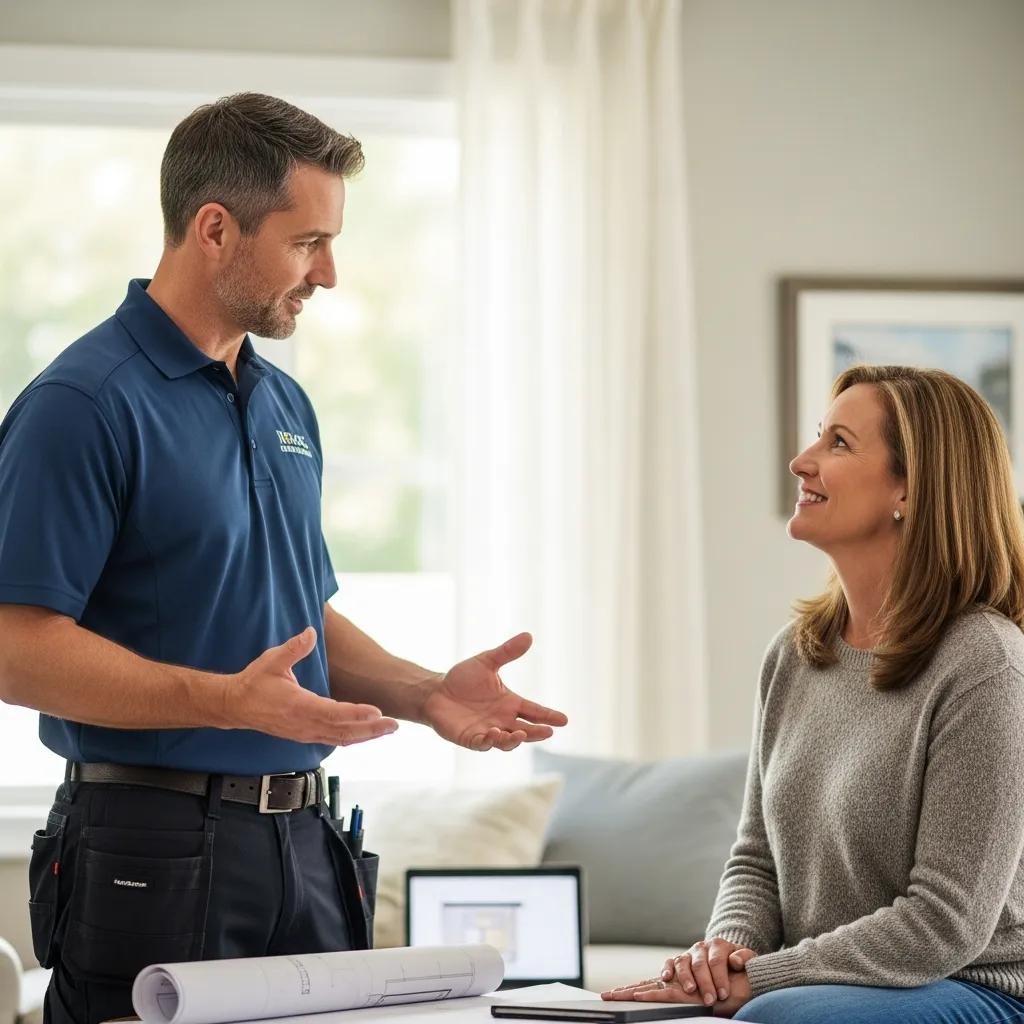
The RPC Framework — Rapport, Professionalism, Close — gives a simple sequence you can use on every visit so needs assessment is reliable and repeatable. Rapport gets homeowners talking honestly, professionalism demonstrates you can deliver, and the close ties the confirmed needs to a clear recommendation. Practically: rapport draws stories and specifics, professional behavior backs claims with evidence, and closing frames the ask around the homeowner’s priorities. The next sections show specific rapport tactics that surface hidden issues and how professional cues and closing language lock the assessment into a workable proposal.
What Role Does Rapport Building Play in Understanding Client Needs?
Rapport lowers guardrails and gets homeowners to share budget, timing, and past contractor headaches. Simple rapport moves include mirroring plain language, dropping a quick local reference, and asking a low‑pressure curiosity question like “what made you start looking now?” — that one reveals urgency and motivation. When a homeowner relaxes into a story about a past contractor mistake, you’ll learn what trust repair needs to be included in your scope. Watch micro‑behaviors — pointing, pauses, emphasis — for instant clues about what matters most.
How Do Professionalism and Closing Techniques Integrate with Needs Assessment?
Professionalism reduces skepticism so your discovery lands without defensive pushback; closing techniques then convert validated needs into signed agreements. Professional cues include arriving on time, having clean, concise paperwork, and showing visuals that reference the homeowner’s stated pain. The close should explicitly link your scope to the problems you found (for example: “Because the leak is affecting the attic insulation and resale value, this scope fixes both now and prevents mold later”), which ties the investment to outcomes and lowers objections. Together these elements make the proposal read like a solution to a verified problem, not a generic price list.
After learning RPC in practice, many teams want a structured training path to embed the habits. Home Improvement Closer (HIC) offers tiered training that turns RPC into repeatable behavior: the free Foundation for Construction Sales course, Mastery of Contractor Sales at $149/month or $1,788/year, and an Ownership of Contracting Business tier at $250/month (annual billing, two months free). These tiers help crews move from individual skill work to business‑level implementation on the jobsite.
What Strategic Discovery Questions Help Contractors Identify Homeowner Pain Points?
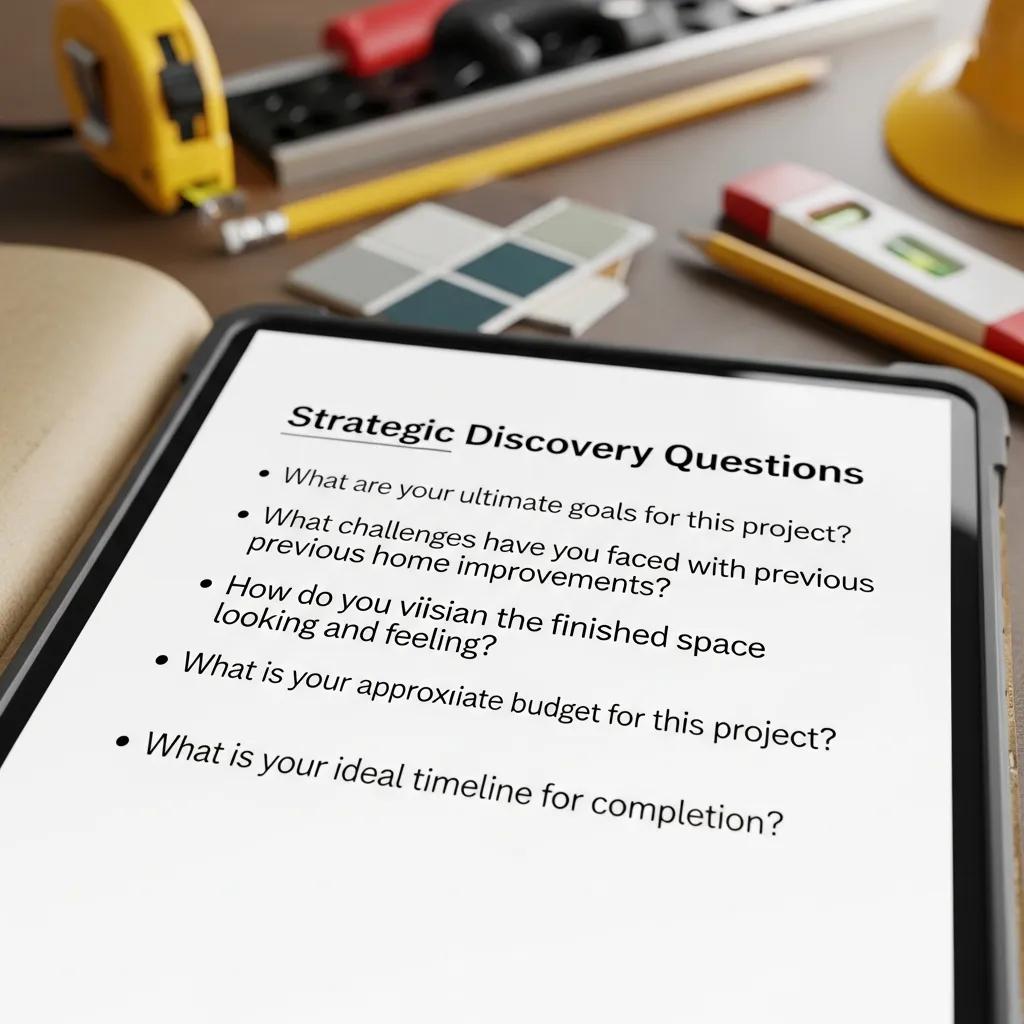
Strategic discovery questions are the core of needs assessment. They’re designed to expose motive, constraints, and decision criteria so your recommendation aligns with what the homeowner actually values. The trick is sequencing: start broad to build context, then narrow to uncover budget flexibility, timing limits, and hidden risks. Below is a compact, actionable question bank you can copy into scripts or CRM templates and use on first site visits to surface decision drivers fast.
Which Open-Ended Sales Questions Reveal Deep Client Needs?
Open questions turn surface complaints into real priorities; follow with targeted probes to confirm the buying driver. Use these high‑impact openers and lean into the intent behind each.
- What prompted you to look at this project now? — Finds urgency and timing drivers.
- How does this problem affect your day‑to‑day or future plans for the house? — Reveals emotional cost and stakes.
- What have you tried so far to fix or manage this? — Shows past experience and trust friction.
- When the project is done, what outcome matters most to you? — Identifies the desired benefit.
- Do you have a budget range in mind we should know about? — Opens budget qualification without pressure.
- Who else will be part of the decision and what matters to them? — Uncovers stakeholders and secondary drivers.
- How important is a long warranty or low maintenance compared to upfront cost? — Exposes value vs. price preference.
- If there was one guarantee that would make you comfortable signing today, what would it be? — Surfaces immediate objections you can address.
Sequence these so answers flow from context to commitment; follow up with “Can you tell me more about that?” to reach root causes. Role‑play the sequence and store answers in CRM fields to make handoffs to estimators and project managers cleaner.
How Can Contractors Use Pain Point Identification Scripts Effectively?
Scripts work when they’re short, flexible, and rehearsed until they sound natural. A reliable structure: quick greeting and rapport, contextual opener, targeted probe, confirmatory summary, transitional proposal line. Example: “Thanks for showing me — what did you notice first and how has that affected you? So I’m hearing X, Y and Z; would it be OK if I show you an option that solves those and explains the costs?” That validates and opens the proposal. Record short micro‑lessons between jobs and keep a script vault on the crew’s phone for refreshers and CRM copy‑paste.
For teams that want deeper practice, HIC’s Mastery of Contractor Sales focuses on scripting, objection handling, and pricing confidence ($149/month or $1,788/year). One‑on‑one coaching sessions are also available to reinforce script adoption on real jobs — with live feedback and downloadable templates teams can deploy right away.
How Can Contractors Interpret Homeowner Psychology to Improve Needs Assessment?
Interpreting homeowner psychology turns answers into prioritized decision criteria by mapping emotional drivers, buying signals, and communication styles to the right solution mix. Two homeowners with the same technical issue may want different outcomes — one wants the cheapest quick fix, another wants longevity and curb appeal — and your assessment has to reveal which path to recommend. This section spells out common emotional drivers, the buying signals that reveal them, and how to match your communication to the homeowner’s decision style.
What Are Common Homeowner Buying Signals and Emotional Drivers?
Buying signals are verbal and non‑verbal cues that show interest, risk tolerance, and urgency. Common emotional drivers are safety, pride/curb appeal, convenience, and avoiding future costs. Verbal signals: timing questions (“When can you start?”), material specificity (“We want X”), or conditional language (“If you can do X, then…”). Non‑verbal signals: lingering over a sample, pointing at problem areas, or nodding during warranty talk. Spotting these cues tells you which proposal elements to highlight and when to push for a decision.
How Do Communication Styles Affect Client Needs Analysis?
Match your delivery to the homeowner’s style — direct, transactional, or relational — to improve clarity and reduce missteps. Direct clients want facts, timelines, and numbers up front; transactional clients respond to clear ROI and guarantees; relational clients need more rapport, references, and stories. Swap language accordingly: bullets and figures for direct people, outcome‑focused ROI for transactional, and neighborhood references and reassurance for relational clients. Matching style speeds negotiations and raises the chance they accept your recommended scope.
How Should Contractors Present Solutions and Value Based on Needs Assessment Insights?
Present solutions in a problem‑first structure that mirrors the homeowner’s stated pains and shows the path from problem to outcome to investment. Lead with a concise problem statement, outline the recommended fix, list benefits tied to the homeowner’s drivers, then finish with an investment section that justifies price using the cost‑of‑doing‑nothing and tangible value. The subsections below give a checklist for tailored proposals and explain value‑based pricing language that reduces sticker shock and positions premium options correctly.
What Are Best Practices for Tailoring Proposals to Homeowner Pain Points?
A tailored proposal opens with the homeowner’s own words describing the problem, then maps features to benefits and closes with proof points like references, photos, and warranty terms. Include annotated photos or simple visuals showing the issue and the fix, and add a short “what this fixes” bullet list that translates technical scope into homeowner outcomes. Break pricing down into line items tied to the specific pain each one resolves to cut sticker shock and speed decisions. Below is a quick proposal‑element table you can use to build value‑focused documents.
Introductory note: this table maps common proposal elements to homeowner needs and gives language you can use to justify investment.
| Proposal Element | Client Need Addressed | Pricing Justification / Language to Use |
|---|---|---|
| Problem Statement | Makes the homeowner’s pain and urgency clear | “This addresses X, which is causing Y risk and will save Z over time.” |
| Scoped Solution | Links the technical fix to the homeowner’s pain | “We recommend this material because it prevents recurrence and lowers maintenance needs.” |
| Benefits List | Shows the homeowner what they get | “Improves safety, prevents mold, and preserves resale value.” |
| Visual Proof | Builds trust and clarifies the work | “Annotated photos show exactly what will be repaired and why.” |
| Warranty & Maintenance | Reduces perceived risk | “Includes an X‑year warranty to protect your investment and give you peace of mind.” |
How Can Value-Based Pricing Help Justify Premium Offers?
Value‑based pricing ties the price to outcomes homeowners care about — lower energy bills, avoided future repair costs, or faster resale — instead of just material plus labor. Homeowners who see clear financial or emotional returns accept higher investments when those returns match their drivers. Use concrete language: quantify savings, explain avoided costs, and compare the “do nothing” scenario to the recommended option. Give numeric examples where possible (for example, projected energy savings over X years) and use short negotiation anchors: “This option fixes the leak and prevents an estimated $X in mold remediation later, which is why the investment is Y.” For teams ready to scale these practices, HIC’s Mastery of Contractor Sales and Ownership of Contracting Business tiers help convert assessment insights into consistent pricing and proposals.
What Are Common Homeowner Pain Points and How Can Contractors Address Them Through Needs Assessment?
Homeowner pains usually cluster around budget, trust, timing, unclear scope, and disruption. Effective needs assessment maps each pain to a discovery question and an on‑site tactic so you neutralize objections before the proposal. The method: ask the right question early, validate with observation, and include a proposal element that fixes the pain. The table below is a quick field reference you can copy into mobile templates.
Introductory note: use this table as a fast reference to turn a homeowner complaint into a discovery question and an immediate on‑site tactic.
| Pain Point | Typical Cause / Buying Driver | Discovery Question + Quick Response Strategy |
|---|---|---|
| Budget Concerns | Fear of overspending or unknown costs | “What budget range did you plan for this?” + offer phased options and clear line‑item pricing. |
| Trust / Past Bad Experience | Previous contractor failure or lack of proof | “Have you had work like this done before?” + show before/after photos and local references. |
| Timing Pressure | Need for fast completion or seasonal constraints | “When do you need this finished?” + offer realistic schedule and a fast‑start option. |
| Uncertainty About Scope | Homeowner unsure what’s required | “What outcome matters most to you?” + present simple scope tiers with clear explainers. |
| Disruption Concerns | Worry about mess and daily disruption | “How do you want us to handle access and cleanup?” + explain containment, cleanup routine, and staging plan. |
How Do Budget Concerns and Trust Issues Impact Sales Conversations?
Budget concerns can hide genuine financial limits or be a negotiation move; separating the two needs a direct but respectful budget qualifier and an offer of phased scopes. Trust issues show up as extra scrutiny, constant comparisons, or requests for guarantees. Field responses: immediate social proof (local references, photos), explicit warranties, and a short “how we work” walkthrough that demonstrates process and communication. Those measures reduce perceived risk and let value conversations continue.
What Strategies Prevent Objections by Addressing Pain Points Early?
Prevention starts during discovery and carries into the proposal: qualify budget early, document findings visibly on site, present tiered solutions, and include warranty and maintenance verbiage to minimize future pushback. Use a summary script before you show price — “Based on X, Y, and Z, here’s the option that solves the core issue and why” — to reframe price as the cost of a specific outcome. Offer limited fast‑start options for time‑sensitive clients and a clear cost‑of‑doing‑nothing comparison to create urgency. Consistent use of these steps shortens decisions and improves close rates.
For teams ready to apply these tactics daily, Home Improvement Closer offers entry and advanced pathways: the Foundation for Construction Sales tier is free and gives immediate frameworks to use on site, while Mastery of Contractor Sales at $149/month or $1,788/year and the Ownership of Contracting Business tier at $250/month (annual billing with two free months) help teams operationalize scripts, templates, and pricing. HIC also offers a free 60‑minute one‑on‑one strategy session (valued at $1,500) to diagnose your biggest conversion blockers and deliver a focused action plan aligned with the RPC approach.
Final note: run a quick needs‑assessment checklist on your next visit, use the discovery scripts above to confirm buyer drivers, and consider the free Foundation for Construction Sales training as a practical next step. If you want live diagnosis, the free 60‑minute one‑on‑one consultation from Home Improvement Closer gives hands‑on, no‑BS strategy time to prioritize the changes that will lift close rates and pricing confidence.
Frequently Asked Questions
What are the key components of an effective needs assessment for contractors?
An effective needs assessment has three core parts: observation, targeted questioning, and active listening. Observation lets you spot visible issues; targeted questions uncover motivations and limits; active listening ensures you fully understand the homeowner’s concern. Put together, these steps let you diagnose the real problem and propose a tailored solution that resonates with the homeowner and improves close rates.
How can contractors improve their questioning techniques during needs assessments?
Get better at questioning by using open‑ended prompts that get homeowners to explain their situation. Start broad to set context, then drill into specifics that reveal priorities and constraints. Use reflective listening — summarize what they told you — to validate concerns and invite more detail. Role‑playing these sequences helps you sound natural and effective on actual visits.
What role does follow-up play in the needs assessment process?
Follow‑up proves you’re committed to solving the homeowner’s problem. After the initial visit, check back to clarify questions, share additional info, or present a tailored solution based on their feedback. Consistent follow‑up builds trust, prevents misunderstandings, and keeps the conversation moving toward a decision.
How can contractors effectively handle objections during the sales process?
Handle objections by listening first, acknowledging the concern, then using your discovery notes to address it with specific evidence or examples. Framing the discussion around outcomes — not just price — helps shift the focus to value. Use proof points like photos, references, and warranty language to reduce doubt.
What are some common mistakes contractors make during needs assessments?
Common mistakes: not asking open questions, failing to listen fully, and assuming you know the homeowner’s priorities. Rushing the assessment to get to price also misses chances to uncover real drivers. Slow down, have a conversation, and confirm what you heard before proposing a scope.
How can contractors leverage technology to enhance their needs assessment process?
Use a CRM to track homeowner interactions, preferences, and pain points. Digital templates and script libraries speed on‑site capture, and video calls can extend your reach for remote assessments. Technology helps keep notes organized and makes handoffs to estimators and PMs cleaner and faster.
Conclusion
Mastering needs assessment lets contractors uncover homeowner pain points and deliver tailored solutions that build trust and close more work. With structured questions and active listening you can turn client conversations into value‑focused proposals instead of price battles. Use the RPC Framework and the strategic discovery questions above to make proposals that actually match homeowners’ priorities. Start sharpening your approach on the next visit — and take advantage of our training and tools to lift your team’s conversion rates and pricing confidence.