

Role-Playing Exercises to Master Objection Handling in Home‑Improvement Sales

Role‑playing exercises give contractors a safe, repeatable way to rehearse real customer conversations—responding to common objections, tightening language, and building closing habits that hold margins. Well‑designed drills recreate the on‑site pressure and decision moments that trip up reps, which builds muscle memory, speeds conversational flow, and reduces reflexive discounting during estimates. Teams that commit to focused objection drills shift from reactive fixes to clear, value‑driven conversations—more signed contracts and healthier job profits follow. This guide catalogs the most common objections in home‑improvement work, supplies ready‑to‑run role‑play scenarios, explains dependable frameworks like RPC and ARO, and shows simple KPIs and micro‑practice routines you can use today. We also introduce Home Improvement Closer (HIC) and explain how its Tier 1 and Tier 2 programs put these drills into practice. Read on for trade‑specific scripts, drill templates you can run between jobs, and a clear progression from beginner practice to mastery.
Home‑improvement estimates are high‑value, high‑trust conversations. Role‑play closes the gap between knowing what to say and saying it confidently. By the end of this piece you’ll have scenario outlines, feedback templates, measurable practice KPIs, and a daily practice cadence designed to help you convert more estimates into signed agreements. The next section lists the objections you’ll see most in remodeling, roofing, and systems work and includes a quick reference table to speed up your morning drills. That inventory sets the stage for targeted exercises and the advanced techniques that follow.
What Are the Most Common Home Improvement Sales Objections?
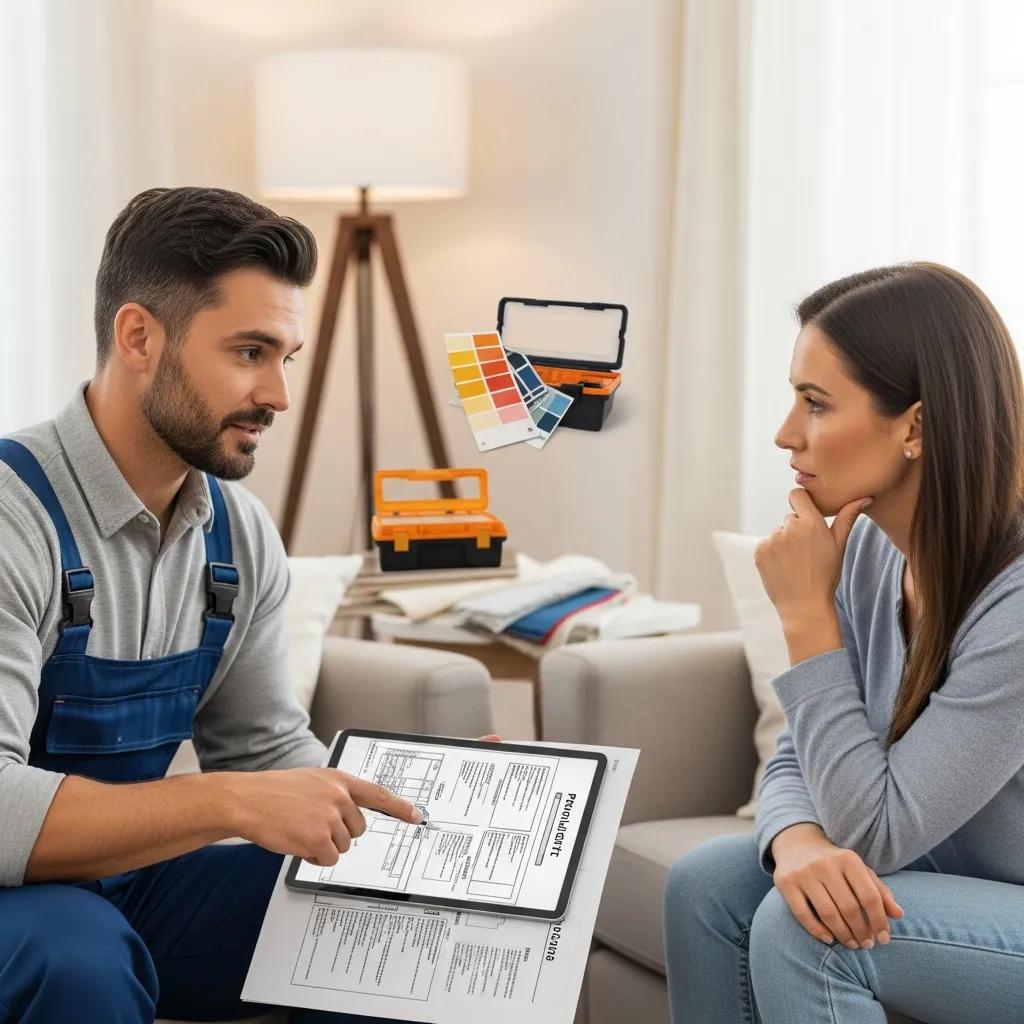
Most buyer objections are surface lines that hide a deeper concern—unclear value, timing of funds, or the need to consult someone else. When you train to find the root cause, role‑play becomes a tool for surfacing hidden objections and reframing the conversation without cutting price. Below we list the frequent pushbacks you’ll hear on estimates and give a focused practice objective for each, so every drill has a clear learning goal. Use these summaries as a warm‑up checklist to make sure each session targets both the complaint and its likely cause.
These six objections show up across trades and form the backbone of any contractor role‑play library:
- Price is too high: The prospect points to cost, often masking a value or scope misunderstanding.
- I need to think about it: A stall that usually hides timing, authority, or trust issues.
- We got a cheaper bid: A direct competitor comparison that demands differentiation and proof.
- Not in the budget: Often a timing or prioritization issue rather than a flat refusal.
- I need to talk to my spouse/partner: A decision‑maker objection that needs a clear next step.
- I don’t see the need right now: Low urgency or unclear value—an education opportunity.
Use these objections to build a practice roadmap: decide whether the drill should anchor price, reframe scope, or push for a commitment. That roadmap leads into trade‑specific scenarios in the following subsections.
Different objections demand different drill focuses. The quick table below helps you pick the right objective before each practice round.
| Objection Type | What it Indicates | Quick Role-Play Focus |
|---|---|---|
| Price is too high | Perceived value mismatch or scope confusion | Practice value pivots and precise scope clarification |
| I need to think about it | Stalling or hidden concerns | Drill probing questions and mini‑commitment closes |
| Cheaper competitor bid | Differentiation and proof needed | Rehearse evidence‑based comparisons and confident walk‑away language |
| Not in the budget | Timing/affordability vs. priority | Practice phased scopes and straightforward financing language |
| Need to talk to spouse | Decision‑maker absent or risk avoidance | Role‑play scheduling calls and short co‑decisioner conversations |
| Don’t see the need | Low perceived urgency | Drill consultative education and downside framing |
This table helps teams pick the right drill for a morning huddle and flows into the tactical scripts for price and decision‑maker objections that follow.
Which Price Objections Do Contractors Face and How Can Role‑Play Help?
Price pushbacks show up as lowball comparisons, mis‑scoped estimates, or sticker shock—each needs a different response to protect margin. Role‑play forces reps to practice anchors, value‑pivot language, and bundled or phased options until those responses are automatic. A simple script beat for scope confusion: ask clarifying questions, give a one‑line value summary, then present an anchored package price to reframe the decision. Run drills in three rounds: 1) buyer raises price, 2) rep clarifies scope and pivots to value, 3) rep secures a next step or offers a phased alternative.
Coaches should time rounds and score on clarity, confidence, and pricing discipline. That tight feedback loop prepares teams to handle sticker shock consistently and keep margins intact, then move cleanly into “I need to think about it” scenarios.
How to Handle “I Need to Think About It” and Decision‑Maker Objections?
“I need to think about it” usually hides budget concerns, timing, or the need to consult a partner. The goal in role‑play is to surface the real barrier without pressuring the homeowner. Effective drills train reps to ask calibrated probes, secure micro‑commitments (like a short follow‑up call), and run scenarios where a decision‑maker joins the call for a minute. A typical sequence: acknowledge the need to decide, ask one calibrated question to reveal the blocker, then ask for a small next step that preserves momentum.
Practice a two‑minute re‑engage call and rehearse summarizing the value in one sentence—micro‑scripts that keep "thinking" from becoming a dead end. That rhythm leads into how repetition and feedback improve objection handling overall.
How Do Sales Role‑Playing Exercises Improve Objection‑Handling Skills?
Role‑playing improves objection handling by pairing realistic scenarios, repetition, targeted feedback, and measurable goals to build behaviors you can rely on in the field. Simulated interactions trigger the same emotions and conversational pressure as live talks; repetition rewires automatic replies from defensive to value‑focused. Scripts and drills build muscle memory while structured feedback highlights specific behaviors to start, stop, or continue. measurable outcomes include higher close rates, less discounting, and faster decisions—tracked with simple KPIs like objection conversion and price recovery.
Below are the main benefits teams will see from steady role‑play practice.
- Realism: Simulations recreate pressure so reps respond authentically on site.
- Immediate feedback: Quick critique corrects habits before they cost you money.
- Muscle memory: Repetition makes effective language automatic.
- Confidence transfer: Reps show up on estimates with authority and fewer concessions.
Structured practice with clear measurement turns those benefits into predictable performance improvements—exactly why teams invest in repeatable programs.
If you want guided, repeatable practice, structured programs layer scenarios, scripts, and coach feedback into a progressive curriculum. Tiered offerings let new reps start with fundamentals and advance to mastery with video lessons and a script vault—moving teams from random practice to reliable training.
What Are Effective Role‑Play Scenarios for Contractor Sales Objections?
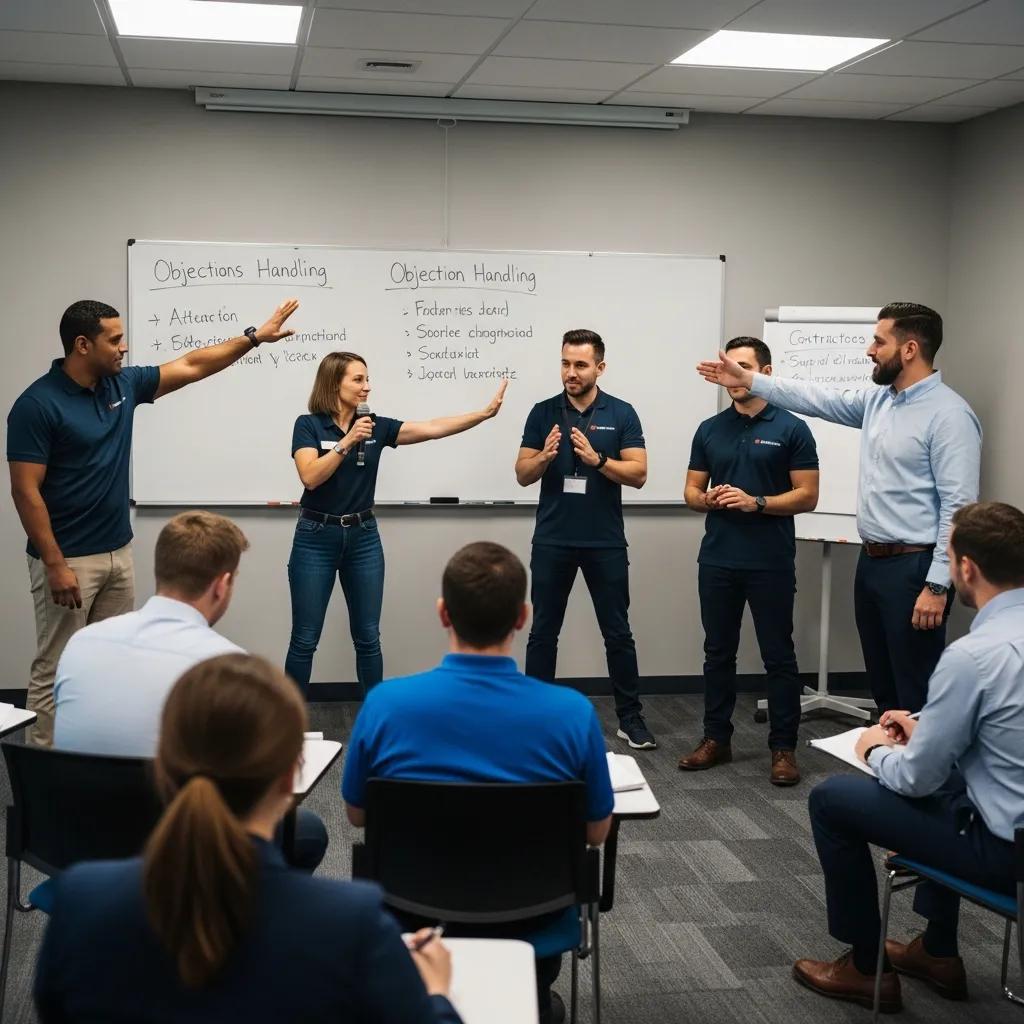
Good scenarios mirror the situations crews see most often: an on‑site estimate with price pushback, a follow‑up where a spouse is the decision‑maker, and a post‑bid call comparing a cheaper quote. Each scenario should include context, defined roles (owner, rep, coach), the objection to surface, and a measurable goal—like “secure a next step 70% of the time.” Use short, mobile‑friendly video prompts: record the round, review language and tone, and iterate between jobs.
Rotate core scenarios weekly—on‑site estimate, competitor comparison, spouse follow‑up—to keep skills fresh and applicable. Those drills feed straight into measurable KPIs and confidence metrics covered next.
Online simulation tools can add structure and feedback to these scenarios, making practice easier to scale.
Online Sales Role Play Simulation for Skill Development
The online role‑play simulation described here highlights practitioner‑identified skills and includes background materials, buyer and seller profiles, a sale/no‑sale decision matrix, and a grading rubric—allowing for a range of selling scenarios. Both buyer and seller are active in the outcome, which helps learners understand buyer motivations more deeply. This interactive tool helps instructors align curriculum with field needs and lets students experience the ambiguity and pressure of professional selling while practicing adaptive techniques.
Sales Role Play: An Online Simulation., 2017
How Does Practicing Role‑Play Build Sales Confidence and Closing Rates?
Role‑play builds confidence by normalizing hard conversations and giving reps dependable language to handle objections. Confidence reduces anxiety‑driven discounts and improves closing behavior. Repetition increases fluency, which lowers cognitive load and produces faster, clearer closes. Track KPIs like close rate, percent of estimates won without discounts, and objection‑to‑close conversion to measure gains. For example, a rep’s discounting rate can drop from 18% to 6% after eight weeks of twice‑weekly drills.
Set practice targets—three short drills per week, one recorded round, one coach review—to ensure role‑play translates into stronger performance on estimates.
What Are Proven Techniques for Mastering Sales Objections in Home Improvement?
Effective objection handling in our space uses repeatable frameworks: RPC, Acknowledge‑Reframe‑Overcome (ARO), active listening, probing questions, and value‑based selling. These give reps a clear path through tough conversations so replies don’t feel improvised. Embedding these techniques into drills ensures responses stay consistent, defensible, and aligned with price discipline. Below are the core techniques and why they work for contractors.
- RPC Framework: Rapport + Professionalism + Close—build trust, show trade credibility, then ask for the next step.
- ARO Method: Acknowledge the objection, Reframe the decision around value or risk, and Overcome with proof or options.
- Active listening and probing: Use calibrated questions to unearth hidden objections and tailor your response.
How Does the RPC Framework Enhance Objection‑Handling Mastery?
RPC sequences each interaction so objections don’t become anchors. Rapport opens trust, professionalism establishes scope and credibility, and the close asks for a small, measurable commitment. In role‑play, reps practice site rapport lines, tight professionalism beats (scope summaries), and soft closes that secure next steps instead of pushing for an immediate signature. Scoring each round on the three RPC pillars helps coaches zero in on the weakest area and lift overall performance.
Apply RPC in every scenario and measure whether reps hit each pillar—then coach to the gap.
What Is the Acknowledge, Reframe, Overcome Method for Objections?
ARO—Acknowledge, Reframe, Overcome—is a clean, three‑step script to handle objections without escalating. First, acknowledge the concern to validate the homeowner. Next, reframe the issue toward value, risk, or priority. Finally, overcome with proof, guarantees, or a phased solution. Example for price: “I hear cost is a concern” (acknowledge). “Most customers care more about long‑term performance than initial price” (reframe). “Here’s how our materials and warranty protect that investment” (overcome). Drill each step until the transitions feel natural.
Using ARO in practice cuts down on defensive bargaining and moves the conversation toward buying criteria, not discounts.
Which Role‑Playing Scenarios Are Best for Specific Contractor Objections?
Match scenarios to trade realities so language sounds credible on site. Roofers face lowball bids and insurance questions; remodelers handle scope creep and design pushback; HVAC techs contend with strict budgets and safety urgency. Tailored drills let reps use trade‑specific language that homeowners trust. The table below maps trades to common objections and recommended drills to help teams build a focused practice plan.
| Trade | Common Objection | Recommended Role-Play Drill |
|---|---|---|
| Roofers | Cheaper competitor bid | Drill differentiators, material proof, and insurance‑focused value pivots |
| Remodelers | Scope/price confusion | Drill scope‑clarifying questions and bundle vs. phased options |
| HVAC | Budget timing | Drill concise financing language and urgency framing for safety/compliance |
How to Role‑Play Price Objection Scenarios for Remodelers and Roofers?
Remodelers should practice clarifying scope in the first 30 seconds, then pivot to outcomes and material benefits—sample beat: clarify, restate value in homeowner terms, offer a phased option. Roofers should emphasize warranty, material quality, and storm resilience—practice short evidence beats and comparisons that justify a higher upfront price. Use coach prompts like “Did rep keep the price anchor?” and “Was the value pivot concise?” to keep feedback focused.
Scorecards should track margin preservation, whether a micro‑commitment was secured, and whether next steps were summarized—so practice drives measurable onsite behavior.
What Are Effective Role‑Play Drills for Handling Competitor Bids and Budget Concerns?
Competitor‑bid drills focus on differentiation and confident walk‑away language: rehearse a three‑sentence differentiation statement, two proof points, and an optional phased offer. For budget issues, practice phased scopes, financing options, or reprioritizing deliverables. Include a “cheaper bid” rapid‑response drill where the rep has 60 seconds to reframe and present a single margin‑protecting alternative.
Those drills teach reps to defend value instead of reflexively discounting and naturally feed into structured training resources that consolidate skill retention.
Role‑playing’s strategic use—such as forecasting competitor responses to pricing changes—shows its value in simulating complex, multi‑party decision scenarios.
Role Playing for Sales Forecasting and Decision Simulation
Role playing can be used to forecast decisions—for example, “how will competitors react if we lower prices?” In these exercises, administrators assign roles and use players’ choices as a proxy for likely outcomes. Effective role plays match the real situation in key ways: role players should resemble the actual participants and receive clear role instructions beforehand. Role playing tends to work best when competing parties respond to large changes. A review found role playing matched real results in seven of eight experiments; in five real situations it correctly predicted outcomes 56% of the time versus 16% for unaided expert opinion. Role playing has also been used successfully in military, legal, and business settings.
Role playing: A method to forecast decisions, JS Armstrong, 2001
How Does Home Improvement Closer’s Training Support Objection‑Handling Mastery?
Home Improvement Closer (HIC) builds contractor‑specific training with a tiered, trade‑focused curriculum that maps directly to role‑play practice and objection drills. Core programs include a free Tier 1 Foundation for Construction Sales and a paid Tier 2 Mastery of Contractor Sales ($149/month) that covers 11 major objections with 51 videos, a script vault, and Q&A replays. Tier 3 and 1‑on‑1 consulting offer deeper personalization for teams that want hands‑on coaching. HIC embeds RPC and ARO into lesson plans, pairs video micro‑practice with downloadable scripts, and supports community Q&A so teams can apply lessons fast. The compact table below maps tiers to offerings and outcomes so you can pick the right entry point for your crew.
| Program Tier | Core Offerings | Outcomes / Benefits |
|---|---|---|
| Tier 1 Foundation (free) | Introductory scripts, basic drills, onboarding modules | Builds objection awareness and basic role‑play habits |
| Tier 2 Mastery ($149/month) | 51 videos, script vault, Q&A replays, 11‑objection modules | Advanced role‑play routines, confident pricing, improved conversion |
| Tier 3 & 1-on-1 | Personalized coaching, tailored drills | Rapid skill acceleration and team‑specific implementation |
This tier map shows how HIC turns random practice into a repeatable curriculum: Tier 1 gets crews started with essential scripts and short drills, Tier 2 adds advanced objection modules and an on‑demand script vault, and Tier 3 brings personalized coaching tied to your KPIs.
Tiered programs work because they give teams a roadmap—from simple daily drills to a disciplined mastery path—so training becomes part of your routine, not an afterthought.
How Does Tier 1 Foundation Build Basic Objection‑Handling Skills?
Tier 1 gives the essentials: core objection categories, simple role‑play templates, and short video examples to help new reps internalize RPC and ARO. Modules focus on the most frequent objections, quick probes, and micro‑commitment closes that fit into job‑site rhythms. Ten‑to‑fifteen minutes of daily practice on these starter scripts builds baseline fluency and prepares crews for Tier 2. Short‑term wins include less casual discounting and clearer, faster estimate conversations.
The free Tier 1 access lets teams trial the approach before moving into deeper mastery—an easy way to start improving conversions predictably.
What Advanced Objection‑Handling Skills Are Covered in Tier 2 Mastery?
Tier 2 Mastery ($149/month) digs into advanced skills: handling 11 major objections, advanced reframes, access to a role‑play script vault, and replayable Q&A to learn from real field scenarios. Fifty‑one short lessons break techniques into mobile‑friendly micro‑lessons that map to quick drills between jobs. Expected outcomes include better price recovery, higher objection‑to‑close conversion, and consistent team language that protects margins. The blend of videos and scripts helps reps retain skills and apply them live during estimates.
Teams that commit to Tier 2’s cadence of lessons and drills see repeatable improvement as practice converts into performance.
What Are Best Practices for Practicing and Improving Sales Role‑Playing Exercises?
Best practices balance frequency, focused feedback, measurement, and mobile formats so crews can train without losing production. Time‑box drills, use consistent feedback templates, and track a few high‑impact KPIs—close rate, discount frequency, and objection conversion. Record short rounds for self‑review and peer critique to create an effective improvement loop. The checklist below gives tactical steps teams can start using right away.
- Run daily 10–15 minute drills during morning huddles to keep skills sharp.
- Record one drill weekly and review it with a coach or peer for targeted feedback.
- Track three KPIs: close rate, price recovery, and objection conversion.
How Can Contractors Use Peer Feedback and Self‑Assessment in Role‑Play?
Make feedback actionable with frameworks like Start/Stop/Continue or Situation‑Behavior‑Impact (SBI). A simple review template: 1) Situation—name the scenario, 2) Behavior—note the rep’s exact words or actions, 3) Impact—explain the result and recommend one clear change. Keep reviews short and limit feedback to two priorities per round so reps can apply fixes immediately. Self‑assessment prompts—rate confidence, clarity, and the closing ask—help reps track trends and own their growth.
Consistent use of these frameworks builds psychological safety and accelerates improvement, which then shows up in measurable KPIs.
What Are Tips for Incorporating Role‑Playing into Daily Sales Training?
Fit role‑play into daily routines with short, timed drills, mobile video practice, and a rotating scenario bank so training works around the realities of contracting. Five practical tips:
- Start each day with a 10‑minute focused drill and a short feedback checklist.
- Use mobile recordings for quick self‑review and asynchronous coach comments.
- Rotate scenarios weekly to cover price, decision‑makers, and competitor bids.
- Assign accountable practice pairs so each rep has a consistent partner.
- Celebrate small wins publicly to reinforce new behaviors and sustain adoption.
Put it into practice: start small with daily drills, measure three KPIs, and scale training through tiers so objection‑handling becomes a predictable strength for your crew.
Frequently Asked Questions
What are the benefits of using role‑playing in sales training?
Role‑playing gives reps a realistic, low‑risk place to practice hard conversations. It builds confidence, creates muscle memory, and delivers immediate, actionable feedback. That combination improves objection handling, raises close rates, and reduces unnecessary discounting. Structured role‑play helps teams spot and fix weak habits early, making training more effective and focused.
How can I measure the effectiveness of role‑playing exercises?
Measure impact with straightforward KPIs: close rate, objection conversion rate, and discount frequency. Compare those metrics before and after introducing role‑play. Add qualitative measures—peer and coach feedback—and review recorded rounds to spot language and tone improvements. Together, quantitative and qualitative tracking keeps training targeted and results clear.
How often should contractors practice role‑playing exercises?
Consistency beats volume. Short, focused drills of 10–15 minutes daily keep skills sharp; add one recorded session per week for review. Frequent, time‑boxed practice fits into jobsite routines and prevents skills from slipping. Make it part of the day so good habits stick.
What types of scenarios should be included in role‑playing exercises?
Include scenarios that reflect the objections you see most: price pushback, competitor comparisons, and decision‑maker involvement. Tailor scenarios to trades—roofing, remodeling, HVAC—so language is credible on site. Mix straightforward objections with complex situations so reps build a full toolkit.
How can feedback be effectively integrated into role‑playing sessions?
Use structured frameworks—Start/Stop/Continue or SBI—to keep feedback specific and actionable. Limit feedback to two targets per round so reps can apply corrections immediately. Record sessions for self‑review and combine peer critique with coach input to speed improvement.
What role does technology play in enhancing role‑playing exercises?
Technology makes role‑play easier and more scalable: mobile recording, remote sessions, and simulation tools let teams practice anywhere. Platforms can store recordings, track KPIs, and enable asynchronous coach feedback—helping crews fit training into busy schedules while keeping it data driven.
Conclusion
Structured role‑playing is one of the fastest ways to improve objection handling for contractors. Regular, targeted practice builds confidence, preserves margin, and converts more estimates into signed jobs. Home Improvement Closer’s tiered training offers a clear, practical path from basic drills to mastery—start small, measure a few KPIs, and scale what works. Begin using the scenarios and drills in this guide and watch your team handle objections faster, cleaner, and with more confidence.