

How Contractors Can Explain Their Value Beyond Price to Win More Home‑Improvement Jobs

Too many contractors lose work because homeowners shop only on price. Shift the conversation to outcomes and long‑term value, and you’ll win more profitable jobs. This guide shows contractors how to sell benefits (not just features), create a homeowner‑focused UVP, and use scripts and rapport to handle price objections and close confidently. Inside: trade‑specific examples (roofing, HVAC, remodels), a step‑by‑step UVP process, ready price‑objection scripts, and an operational playbook based on our RPC Framework (Rapport, Professionalism, Close). Follow the mapped steps—define value‑based selling, craft a tight UVP, reframe cost as investment, build trust with clear professionalism, apply RPC, then practice and scale. Translate features into homeowner outcomes, rehearse the scripts, and you’ll raise close rates and justify premium pricing without being the cheapest bid.
What Selling Value (Not Price) Actually Looks Like in Home Improvement
Selling value means getting the homeowner to judge your offer by outcomes and reduced risk—not the lowest up‑front cost. The tactic is simple: translate each technical feature into a homeowner benefit—more comfort, longer life, lower upkeep, or stronger resale value—and tie that benefit to the homeowner’s problem. The payoff is less price sensitivity and more willingness to pay for reliable, predictable results. Value‑based selling moves you out of commodity bidding and toward homeowner‑focused outcomes that matter years after the job is done.
Homeowners buy a mix of practical returns and peace of mind. Keep this short checklist handy to match value to common priorities.
- Durability: Fewer repairs and longer lifespan for components.
- Energy Savings: Lower monthly bills and improved comfort.
- Curb Appeal & Resale: Quality work that boosts perceived home value and speeds future sales.
These priorities explain why benefits beat a low number; next we’ll show how to turn features into clear benefit statements you can use on site.
How Benefits Differ from Features in Contractor Sales
Features are technical facts. Benefits are what the homeowner actually experiences. To convert features into benefits, pair each technical claim with a homeowner outcome: a 30‑year warranty (feature) becomes predictable long‑term protection and fewer replacement costs (benefit). Use short paired scripts so the translation happens naturally during conversations. Instead of “we use architectural shingles,” try: “That roofing system keeps your attic cooler and delays a reroof—so you avoid extra maintenance and get better comfort.” These quick conversions reduce homeowner confusion, make price comparisons less sticky, and set you up to show proof.
Why Value Is Crucial When Homeowners Push Back on Price
Homeowners often anchor to the lowest number they see, but psychology matters—loss aversion, a need for certainty, and trust in proven providers make people willing to pay more for reduced risk. Turning lifecycle costs or avoided repairs into an investment conversation reframes price. Pointing to a local case where better materials prevented repeat service calls makes the choice tangible. In high‑risk, disruptive categories like roofing and HVAC, customers increasingly prioritize predictable outcomes. Frame conversations around homeowner priorities and you’ll shift the comparison from “who’s cheapest” to “who solves the problem best,” which raises margins and close rates.
How to Build a Unique Value Proposition Homeowners Actually Get
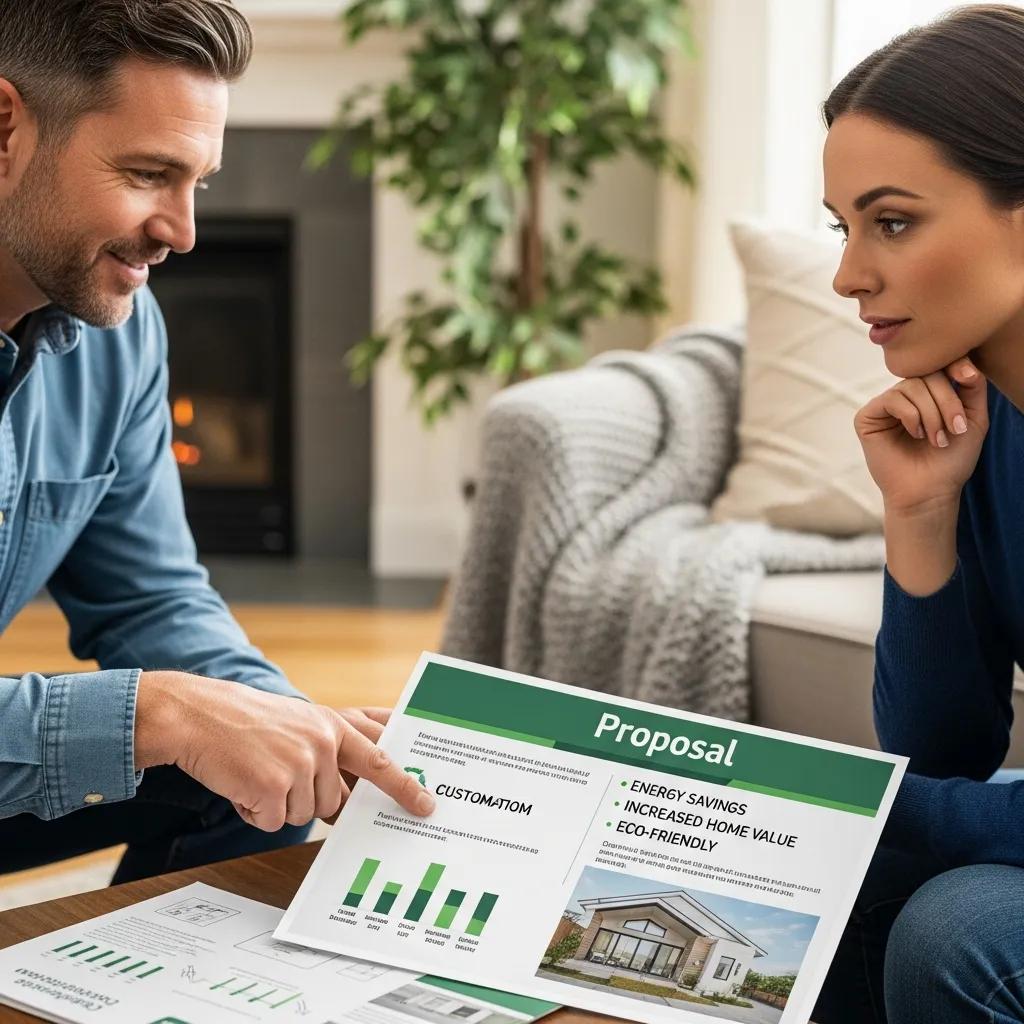
A homeowner‑ready UVP is a short, benefit‑first line that links your strengths to the homeowner’s top pain and a clear proof point. The process is discovery plus proof: learn the homeowner’s main concern, match one capability that solves it, and back the claim with a concrete proof (warranty length, a local case outcome, or a savings estimate). The result is a one‑line headline with a couple of supporting bullets that simplify the decision and give your team a consistent message. Follow this practical, field‑tested sequence to build a UVP homeowners understand on first hearing.
Use these steps to identify and test a UVP that works in your market.
- Research local needs: Note common homeowner problems and how competitors position themselves.
- List differentiators: Pick your top 2–3 strengths that directly solve those problems.
- Select proofs: Choose warranties, before/after photos, or measured outcomes that support each claim.
- Craft a short headline: One line focused on a homeowner outcome.
- Test with prospects: Try it in conversations and refine based on reactions.
That five‑step loop gives you a clean UVP to use on proposals, estimate calls, and on‑site conversations to steer homeowners toward value‑based decisions.
Quick reference table: common differentiators you can use as homeowner‑facing proof.
| Differentiator | Attribute | Homeowner Benefit |
|---|---|---|
| Warranty | Length and transferability | Lower long‑term replacement risk and stronger resale appeal |
| Certified Installation | Trade and manufacturer certifications | Correct installation that preserves product warranties |
| Local Case Studies | Before/after photos and measured results | Real local proof that the solution works |
Choose the three differentiators that matter most to your target homeowner and test those claims in conversations and proposals.
Steps to Identify and Communicate Your Contractor Value Proposition
Start discovery with focused homeowner questions, map their priorities to your strongest proofs, then craft a short message for each scenario. In practice: research the market and customer pain, choose the top differentiators, attach solid proof points, write a concise headline plus two supporting bullets, and test in the field. When you communicate, lead with the headline, follow with the top proof, and close by describing the homeowner outcome—this sequence lowers cognitive load and speeds decisions. Role‑play with teammates to sharpen delivery and keep the UVP consistent across job types.
How to Showcase Specialized Expertise and Quality
Highlight trade expertise with visual proof and homeowner‑first language that links technical choices to tangible outcomes. Use a short portfolio, call out warranties on proposals, add crew bios that emphasize experience, and bring material samples or lifecycle estimates to site visits. Lines like “this system delays major maintenance by X years” quantify advantage without flooding homeowners with jargon. Use these assets consistently in proposals, online listings, and on site so perceived quality matches your price.
Practical Ways to Overcome Price Objections in Home Improvement Sales

Beating price objections means reframing cost into homeowner outcomes, protecting rapport, and giving clear next steps to keep the sale moving. Use discovery‑led reframes, simple ROI sketches, trade‑specific scripts, scoped staging, and social proof in sequence. These tactics reduce price friction and guide homeowners from hesitation to a decision. Below are five proven onsite strategies for handling “too expensive” or “need to think about it.”
- Reframe cost as investment: Show avoided repairs, energy savings, or resale benefits.
- Layer social proof: Share recent, relevant local case studies.
- Offer staged options: Provide Good‑Better‑Best choices to manage budgets without killing perceived value.
- Use empathy and timing: Validate concerns, then propose a short, low‑commitment next step (e.g., a follow‑up to review options).
- Quantify risk reduction: Explain warranties, maintenance intervals, and guarantees to lower perceived risk.
These prioritized moves keep the conversation productive and make it easier to turn price pushback into a value discussion. Practice them with scripts and role‑play so your team executes them consistently in the field.
Quick lookup table: common objections, reframing strategies, and example scripts.
| Objection Type | Reframe Strategy | Example Script / Outcome |
|---|---|---|
| "Too expensive" | Investment framing with avoided costs | "I hear you—let me show how this system cuts utility and repair costs over the next ten years." |
| "Need to think about it" | Time‑limited social proof + clear next step | "Totally—many homeowners like to review one local job; can I show you a similar case this week?" |
| "Lower bid found" | Scope comparison + warranty emphasis | "Let's compare what that bid excludes and how our warranty protects you longer." |
Use this table as a quick guide so salespeople can pick a response pattern and deliver scripts that keep the talk focused on homeowner outcomes.
Structured practice accelerates skill building. Home Improvement Closer offers tiered training where technicians and sales reps rehearse objection‑reframing and role‑play scripts. Tier 1: Foundation is free as a risk‑free starting point. Many teams focused on objection handling move to Tier 2: Mastery ($149/month or $1,788/year) to build consistent pricing confidence via structured practice.
How to Reframe Cost as an Investment for Homeowners
Turn technical advantages into homeowner savings or avoided pain, then explain that conversion simply. Start with two quick anchors: expected maintenance savings and estimated resale uplift. For example, an insulated window upgrade can lower energy bills and delay replacements—frame it as an “X‑year payback” or avoided replacement cost. Short scripts work best: “Over the next ten years, this upgrade typically saves homeowners about $X in maintenance and energy; many clients recover Y% when they sell.” Concrete anchors make price easier to evaluate and shift attention to total homeowner return.
Scripts That Work for “Too Expensive” and “Need to Think About It”
Use direct, empathetic lines that pivot to homeowner outcomes: validate first, then offer a focused next step backed by evidence. For "too expensive": “I get it—what part of the price worries you most? If it’s budget, we can show a staged option that protects what matters.” For “need to think about it”: “I understand. Would seeing a recent local example of this scope and the timeline help you decide with more confidence?” Follow ups can include a short case study, a site‑specific cost‑benefit note, or a staged payment plan. Practice these as part of a standardized sales protocol to keep rapport while defending price.
How Contractors Build Trust and Rapport for Value‑Based Selling
Trust and rapport are the foundation of value‑based selling—homeowners will pay more to reduce uncertainty and feel heard. Combine listening‑based discovery, consistent professionalism signals, and clear process documentation to lower perceived risk. Visible cues—clean uniforms, on‑time arrival, tidy job sites, and professional proposals—signal competence before price talks begin and make homeowners more receptive to value arguments. The result: smoother negotiations and fewer price‑only comparisons.
Easy-to-repeat rapport moves that build trust: ask discovery questions, mirror homeowner language, and summarize concerns before proposing solutions. Those steps create credibility and prepare homeowners to accept outcome‑focused messaging. The next section outlines a professionalism checklist that directly boosts perceived value.
How Professionalism Increases Perceived Value
Professionalism equals reduced risk in the homeowner’s mind—and that allows you to price higher without losing the sale. Concrete actions—clear proposals with defined scope and timelines, crew identification, and written warranties—turn promises into commitments. Small investments like printed materials, plain contract language, and tidy workmanship pay off by increasing willingness to pay for reliability. Demonstrating your process on the initial visit lowers homeowner anxiety and primes them for a value conversation.
Using Client Psychology to Strengthen Conversations
Ethically applying homeowner decision psychology—loss aversion, authority, and social proof—boosts persuasion when tied to clear homeowner outcomes. Ask what happens if a failing component isn’t fixed (loss aversion), cite local examples (social proof), and show credentials or manufacturer authorizations (authority). Sequence these cues: identify the potential loss, present credible local proof, then offer the solution. Timing matters—lead with empathy, then use psychological cues once you know the homeowner’s main concern to avoid sounding manipulative.
How the RPC Framework Helps Contractors Confidently Articulate Value and Close More Deals
RPC—Rapport, Professionalism, Close—is a compact playbook for consistent, value‑driven sales. Rapport builds discovery and alignment, Professionalism delivers trust through process and proof, and Close converts perceived value into a signed agreement. Each step has tactical actions and micro‑scripts that raise pricing confidence and close rates. Standardizing RPC reduces variability across crews and gives owners a repeatable way to justify premium pricing based on outcomes.
Here’s a compact three‑step playbook you can apply in a typical homeowner meeting.
- Rapport: Ask targeted discovery questions and mirror homeowner language to surface priorities and define success.
- Professionalism: Present a clear scope, warranties, and a local case that lower perceived risk and validate your claims.
- Close: Use assumptive language and clear next steps—confirm scope, timeline, and payment options while handling last‑minute objections with the reframes above.
This simple sequence is easy to practice and measure; the table below maps each RPC step to tactical actions and measurable results.
| RPC Step | Tactical Actions | Script / Result Metric |
|---|---|---|
| Rapport | Targeted discovery questions and mirroring | "Tell me the top three things you want fixed" → improves lead qualification |
| Professionalism | Clear proposals, photos, warranties | Show a local case with warranty highlighted → increases acceptance of premium options |
| Close | Assumptive close + last‑objection script | "Shall we schedule the install for next Tuesday?" → raises booking rate |
This EAV‑style breakdown ties each RPC component to practical execution and measurable sales outcomes so field teams can implement and track progress.
If you want guided implementation, Home Improvement Closer teaches RPC and offers tiered training and 1‑on‑1 coaching. Tier 2: Mastery focuses on objection handling and pricing confidence; Tier 1: Foundation provides free starter resources to begin practicing RPC steps.
What Are the Three Steps of RPC: Rapport, Professionalism, Close?
Rapport uncovers homeowner priorities through discovery and listening. Professionalism demonstrates reliability with process and proof. Close turns perceived value into action with clear next steps and defensible pricing. Each step includes micro‑actions—discovery probes for Rapport, documented proposals for Professionalism, and assumptive language for Close—that create a repeatable sales flow. Using RPC at every onsite visit reduces price‑only comparisons and improves conversion. Regular role‑play and scorecarding keep the team sharp and measurable.
How to Use RPC to Charge Premium Prices
RPC lets you justify higher prices because homeowners experience a consistent, low‑risk process focused on outcomes. For example, if Rapport reveals a desire to avoid future disruption, Professionalism provides a documented timeline and warranty, and Close frames the price as an investment in less stress and lower future costs. Teams that execute RPC consistently align homeowner expectations with value‑based pricing. Field checklists and short coaching touchpoints lock those standards into daily work.
Next Steps to Level Up Sales with Home Improvement Closer Training
After you learn these concepts, put a practice and measurement plan in place: pick one UVP to test, run role‑play sessions for objection scripts, score field visits for RPC behaviors, and track close‑rate changes to measure ROI. For teams ready to systematize change, Home Improvement Closer provides a clear ladder of support to practice scripts, scale processes, and get focused coaching that speeds results. Use the outline below to choose the right starting point for your team.
Training tiers mapped to common needs and decision stages:
- Tier 1: Foundation (Free) — Entry resources to standardize discovery and benefit framing for teams new to structured sales training.
- Tier 2: Mastery ($149/month or $1,788/year) — Focused on objection handling, reframing, and pricing confidence to support consistent premium closes.
- Tier 3: Ownership ($250/month) — Designed for owners who want to scale, institutionalize sales processes, and make the business sellable.
Start risk‑free with Tier 1 and scale training as you see measurable improvements; personalized coaching then accelerates adoption.
Which Training Program Best Supports Value‑Based Selling?
Pick the program that matches your team's gap. Need shared language and basic structure? Tier 1: Foundation gives free resources to standardize discovery and benefit framing. Losing bids on price? Tier 2: Mastery ($149/month or $1,788/year) focuses on objection handling and scripts that defend higher pricing. Owners scaling toward sellability should consider Tier 3: Ownership ($250/month) to tie training to business outcomes like profitability and sellability. Each tier scales commitment so you can match investment to near‑term wins and long‑term strategy.
Value‑based selling is a practical way to stand out by emphasizing homeowner benefits and outcomes rather than technical specs alone.
Value‑Based Selling: Capabilities for Differentiating Offerings
For managers, this study lays out the capabilities companies need to practice value‑based selling—shifting from product features to customer outcomes, and using UVPs to win competitive advantage.
Value‑based selling: An organizational capability perspective, P Töytäri, 2015
How 1‑on‑1 Consultations Accelerate Contractor Sales Success
Personalized 1‑on‑1 consultations diagnose issues and provide an implementation plan tailored to your trade, team, and market. Sessions focus on high‑impact changes—script tweaks, role‑play, and field coaching—that produce measurable lifts in close rates and pricing confidence. For teams needing intensive, bespoke support, a focused consultation delivers prioritized actions and accountability to embed new behaviors quickly. Home Improvement Closer also offers 1‑on‑1 consulting priced around $1,500 for contractors who want individualized acceleration and implementation help.
Handling sales objections well is critical in construction and requires both theory and practical application for sales managers.
Sales Objections in Construction: Theory and Practice for Managers
Effectively handling sales objections is essential to a successful sales process in architecture and construction. This work outlines theory and practical approaches managers can use to navigate client concerns and close more deals.
Dealing with sales objections: theory and practice for the architectural and construction manager, D Makatora, 2025
This article laid out trade‑specific tactics, scripts, and an operational framework to help contractors sell value over price and win more profitable work. Implement a UVP, rehearse objection scripts, and use the RPC Framework to create predictable pricing power and compete on outcomes—not just the lowest bid.
Frequently Asked Questions
What are the key components of a Unique Value Proposition (UVP) for contractors?
A contractor UVP should quickly show how your service solves a homeowner’s top pain. Key parts: identify common homeowner problems, list the differentiators that set you apart, and add proof points like warranties or case studies. A clear headline plus a couple supporting details helps homeowners grasp the value fast. Test the UVP with prospects and refine it based on their reactions.
How can contractors use social proof effectively in sales?
Social proof builds trust. Use testimonials, before/after photos, and case studies that mirror the prospect’s situation. Show recent local jobs and measurable outcomes so homeowners can see you’ve solved similar problems. Real examples reduce hesitation and reinforce the value of your proposal.
What role does empathy play in overcoming price objections?
Empathy matters. Listen, validate concerns, then reframe the conversation around value. Acknowledging budget limits while offering targeted, lower‑risk options helps shift the talk from price to benefits. That supportive approach keeps rapport intact and opens the door to solution‑focused discussions.
How can contractors measure the effectiveness of their sales strategies?
Track KPIs like close rate, average ticket size, and customer feedback. Use post‑sale surveys and follow‑ups to gather insights. Also test different UVPs and objection‑handling scripts in the field and compare results. Regular measurement reveals what’s working and where to tweak your approach.
What common mistakes do contractors make when selling value?
Common missteps: leading with technical features instead of homeowner benefits, skipping discovery (so you miss what matters), and failing to address price objections clearly. Also, not providing proof points or customizing messages for each homeowner weakens your position. Tailor the conversation and show evidence.
How can contractors improve their rapport‑building with homeowners?
Practice active listening, ask open questions, and mirror the homeowner’s language. Find common ground, be punctual, communicate clearly, and keep the work area tidy—those small professionalism signals matter. Role‑play scenarios with your team to build comfort and consistency in real interactions.
Conclusion
Focusing on value instead of price helps contractors win more profitable work and build lasting homeowner relationships. By translating technical features into homeowner outcomes, implementing a clear UVP, and practicing objection‑handling within the RPC Framework, your team will gain pricing confidence and close more premium jobs. Start today: pick one UVP, rehearse the scripts, and track your results—then scale the wins with targeted training.